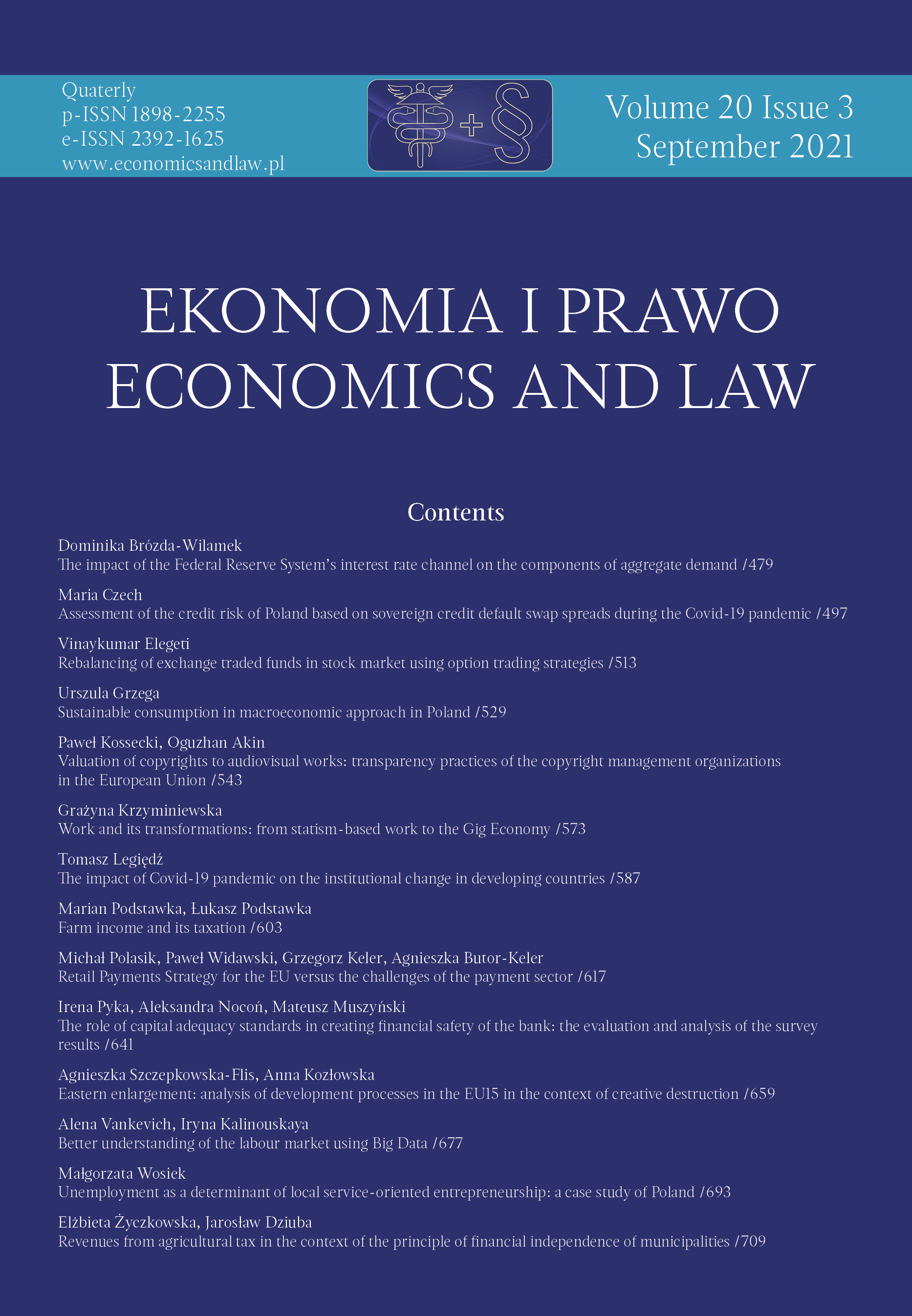
The role of capital adequacy standards in creating financial safety of the bank: the evaluation and analysis of the survey results
DOI:
https://doi.org/10.12775/EiP.2021.038Keywords
financial safety, quality of the own funds, capital adequacy standards, capital buffersAbstract
Motivation: After the global financial crisis, banks’ financial safety has been considered as a public good and put under closer control and supervision. The prudential regulations of credit institutions which are the main subject of the study, have been significantly tightened. Although the minimum level of banks’ own funds, set adequately to the risk, had been a fundamental indicator of banks’ financial safety since the end of 1980s, after the global financial crisis the quality of this capital has changed and the scope of its regulation has been increased. By respecting the new prudential standards of the Basel Committee on Banking Supervision at the international level, financial safety of the banks has been additionally put under the macro-supervision. The concern about the overregulation of the banking system raises many controversies, what justifies conducting research on this subject.
Aim: The main purpose of the article is to identify changes in the bank’s strategies of creating financial safety after the global financial crisis, considering macro- and micro-prudential regulations, aimed at strengthening the level and quality of bank capital, based on the results of the conducted research.
Results: The results of the empirical research indicate that there is a strong belief among management staff in commercial banks in Poland that the increase in the level and structure of the own funds in credit institutions rises their financial safety. The results confirm the intensification of the process of implementing Basel regulations in commercial banks in Poland.
References
BIS. (1996). Amendment to the capital accord to incorporate market risks. Retrieved 10.06.2020 from https://www.bis.org/publ/bcbs24.pdf.
BIS. (2004). International convergence of capital measurement and capital standards: a revised framework. Retrieved 11.06.2020 from https://www.bis.org/publ/bcbs107.pdf.
BIS. (2006). International convergence of capital measurement and capital standards: a revised framework comprehensive version. Retrieved 11.06.2020 from https://www.bis.org/publ/bcbs128.pdf.
BIS. (2010). Basel III: a global regulatory framework for more resilient banks and banking systems. Retrieved 17.04.2020 from https://www.bis.org/publ/bcbs189.pdf.
Directive (EU) 2019/878 of the European Parliament and of the Council of 20 May 2019 amending Directive 2013/36/EU as regards exempted entities, financial holding companies, mixed financial holding companies, remuneration, supervisory measures and powers and capital conservation measures (OJ L 150, 7.6.2019).
Directive 2013/36/EU of the European Parliament and of the Council of 26 June 2013 on access to the activity of credit institutions and the prudential supervision of credit institutions and investment firms, amending Directive 2002/87/EC and repealing Directives 2006/48/EC and 2006/49/EC (OJ L 176, 27.6.2013).
Flejterski, S. (2008). Zaufanie do instytucji bankowo-finansowych jako fundament stabilnego systemu finansowego. In J. Nowakowski, & T. Famulska (Eds.), Stabilność i bezpieczeństwo systemu bankowego. Difin.
KNF. (2017). Pakiet CRD IV/CRR: zmiany polskich regulacji. Retrieved 16.04.2020 from https://www.knf.gov.pl/dla_rynku/pakiet_crd4/zmiany_polskich_regulacji_CRDIV.
Koleśnik, J. (2011). Bezpieczeństwo systemu bankowego: teoria i praktyka. Difin.
Lepczyński, M.(2013). Nowe regulacje w zakresie adekwatności kapitałowej i płynności banków wobec zagrożeń związanych z finansowaniem portfeli kredytów mieszkaniowych w polskich bankach. Zarządzanie i Finanse, 11(1/2), 341–355.
Marcinkowska, M., Wdowiński, P., Flejterski S., & Zygierewicz M. (2014). Wpływ regulacji sektora bankowego na wzrost gospodarczy: wnioski dla Polski. Materiały i Studia, 305, 1–229.
Mitręga-Niestrój, K. (2008). Znaczenie Bazylejskiego Komitetu Nadzoru Bankowego w global governance. In J. Nowakowski, & T. Famulska (Eds.), Stabilność i bezpieczeństwo systemu bankowego (pp. 29–39). Difin.
Pyka, I. (2013). Bankowość komercyjna. Uniwersytet Ekonomiczny w Katowicach.
Pyka, I., Nocoń, A., & Cichorska, J. (2019a). Nowy ład regulacyjny w sektorze bankowym Unii Europejskiej. CeDeWu.
Pyka, I., Zygierewicz, M., Bolibok, P., & Nocoń A. (2019b). Polityka makroostrożnościowa w regulowaniu stabilności sektora bankowego: innowacyjność, implementacja, bariery. Uniwersytet Ekonomiczny w Katowicach.
Regulation (EU) 2019/876 of the European Parliament and of the Council of 20 May 2019 amending Regulation (EU) No 575/2013 as regards the leverage ratio, the net stable funding ratio, requirements for own funds and eligible liabilities, counterparty credit risk, market risk, exposures to central counterparties, exposures to collective investment undertakings, large exposures, reporting and disclosure requirements, and Regulation (EU) No 648/2012 (OJ L 150, 7.6.2019).
Regulation (EU) No 575/2013 of the European Parliament and of the Council of 26 June 2013 on prudential requirements for credit institutions and investment firms and amending Regulation (EU) No 648/2012 (OJ L 176, 27.6.2013).
Rozporządzenie Ministra Finansów z dnia 18 marca 2020 r. uchylające rozporządzenie w sprawie bufora ryzyka systemowego [Regulation of the Minister of Finance of March 18, 2020, repealing the ordinance on the systemic risk buffer] (Dz.U. 2020 poz. 473) (Poland).
Taherdoost, H. (2016). Validity and Reliability of the Research Instrument. How to Test the Validation of a Questionnaire/Survey in a Research. International Journal of Academic Research in Management, 5(3), 28–36.
Ustawa z dnia 5 sierpnia 2015 r. o nadzorze makroostrożnościowym nad systemem finansowym i zarządzaniu kryzysowym w systemie finansowym [Act of 5 August 2015 on macroprudential supervision over the financial system and crisis management] (Dz.U. 2015 poz. 1513) (Poland).
Downloads
Published
How to Cite
Issue
Section
License
Copyright (c) 2022 Irena Pyka, Aleksandra Nocoń, Mateusz Muszyński

This work is licensed under a Creative Commons Attribution-NoDerivatives 4.0 International License.
Stats
Number of views and downloads: 932
Number of citations: 0
