Skip to main content Skip to main navigation menu Skip to site footer
  • Register
  • Login
  • Language
    • English
    • Język Polski
  • Menu
  • Home
  • Current
  • Archives
  • Announcements
  • About
    • About the Journal
    • Submissions
    • Editorial Team
    • Privacy Statement
    • Contact
  • Register
  • Login
  • Language:
  • English
  • Język Polski

Ruch Filozoficzny

Some Remarks on the Interpretative Categories of Early Modern Philosophy
  • Home
  • /
  • Some Remarks on the Interpretative Categories of Early Modern Philosophy
  1. Home /
  2. Archives /
  3. Vol. 72 No. 2 (2016) /
  4. Articles

Some Remarks on the Interpretative Categories of Early Modern Philosophy

Authors

  • Piotr Szałek Katedra Historii Filozofii Nowożytnej i Współczesnej, Wydział Filozofii KUL

DOI:

https://doi.org/10.12775/RF.2016.012

Keywords

Early Modern Philosophy, History of Philosophy Methodology, Rationalism, Empiricism, Max Weber, Ideal Types Theory

Abstract

The paper considers the common strategy of interpreting Early Modern Philosophy   in terms of the following opposing categories: Rationalism and Empiricism.   Following Knud Haakonssen, it analyses origins and the criterion for this distinction   in a formation process of the so-called philosophical history of philosophy   in the nineteenth century. It emphasizes serious limitations of such interpretative   categories and suggests a possibility of the supplementary interpretation   of the seventeenth- and eighteenth-century philosophy in terms of the Weberian   ideal types.  

References

Fisher Kuno, Geschichte der neuern Philosophie, t. 1–6, Stuttgart-Mannheim-Heidelberg: Bassermann 1854–77.

Haakonssen Knud, The History of Eighteenth-Century Philosophy: History or Philosophy?, w: The Cambridge History of Eighteenth-Century Philosophy, t. 1, Cambridge: Cambridge University Press 2006, s. 3–25.

Hill James, The Synthesis of Empiricism and Innatism in Berkeley’s Doctrine of Notions, „Berkeley Studies” 21(2010), s. 315.

Janowski Zbigniew, Teodycea Kartezjańska, Arcana, Kraków 1998.

Kołakowski Leszek, Jednostka i nieskończoność: wolność i antynomie wolności w filozofii Spinozy, PWN, Warszawa 1958.

Stewart Dugald, Histoire Abrégée des sciences metaphysiques, morales et politiques depuis la renaissance des letters, t. 1–3, trad. J.A. Buchon, Paris: Levrault 1820.

Swieżawski Stefan, Zagadnienie historii filozofii, Warszawa: PWN 1966.

Ueberweg, Friedrich, Grundriss der Geschichte der Philosophie, t. 1–3, Berlin: Mittler 1863–1866.

Weber Max, Gesammelte Aufsätze zur Wissenschaftslehre, Tübingen: J.C.B. Mohr 1922.
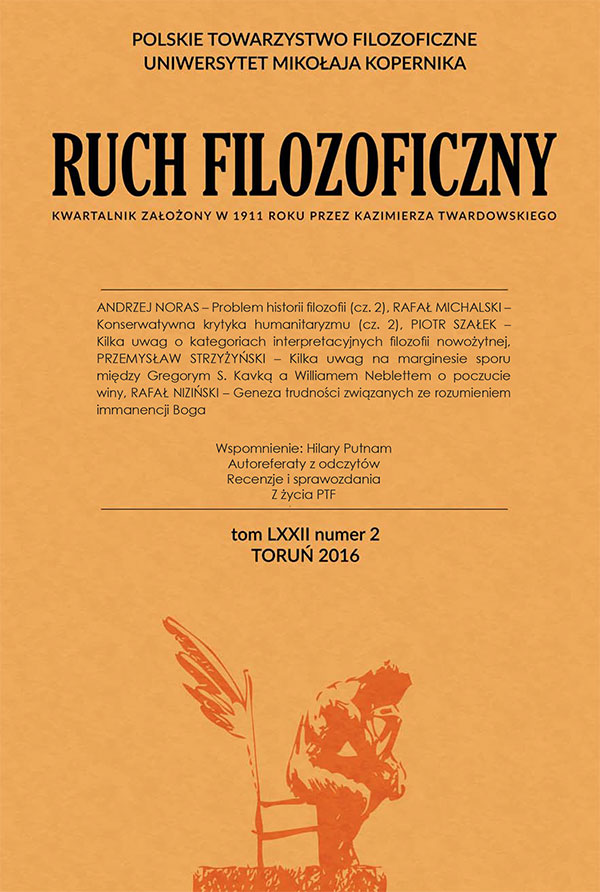
Ruch Filozoficzny

Downloads

  • PDF (Język Polski)

Published

2017-06-10

How to Cite

1.
SZAŁEK, Piotr. Some Remarks on the Interpretative Categories of Early Modern Philosophy. Ruch Filozoficzny. Online. 10 June 2017. Vol. 72, no. 2, pp. 53-62. [Accessed 27 March 2026]. DOI 10.12775/RF.2016.012.
  • ISO 690
  • ACM
  • ACS
  • APA
  • ABNT
  • Chicago
  • Harvard
  • IEEE
  • MLA
  • Turabian
  • Vancouver
Download Citation
  • Endnote/Zotero/Mendeley (RIS)
  • BibTeX

Issue

Vol. 72 No. 2 (2016)

Section

Articles

Stats

Number of views and downloads: 1211
Number of citations: 0

Search

Search

Browse

  • Browse Author Index
  • Issue archive

User

User

Current Issue

  • Atom logo
  • RSS2 logo
  • RSS1 logo

Information

  • For Readers
  • For Authors
  • For Librarians

Newsletter

Subscribe Unsubscribe

Language

  • English
  • Język Polski

Tags

Search using one of provided tags:

Early Modern Philosophy, History of Philosophy Methodology, Rationalism, Empiricism, Max Weber, Ideal Types Theory
Up

Akademicka Platforma Czasopism

Najlepsze czasopisma naukowe i akademickie w jednym miejscu

apcz.umk.pl

Partners

  • Akademia Ignatianum w Krakowie
  • Akademickie Towarzystwo Andragogiczne
  • Fundacja Copernicus na rzecz Rozwoju Badań Naukowych
  • Instytut Historii im. Tadeusza Manteuffla Polskiej Akademii Nauk
  • Instytut Kultur Śródziemnomorskich i Orientalnych PAN
  • Instytut Tomistyczny
  • Karmelitański Instytut Duchowości w Krakowie
  • Ministerstwo Kultury i Dziedzictwa Narodowego
  • Państwowa Akademia Nauk Stosowanych w Krośnie
  • Państwowa Akademia Nauk Stosowanych we Włocławku
  • Państwowa Wyższa Szkoła Zawodowa im. Stanisława Pigonia w Krośnie
  • Polska Fundacja Przemysłu Kosmicznego
  • Polskie Towarzystwo Ekonomiczne
  • Polskie Towarzystwo Ludoznawcze
  • Towarzystwo Miłośników Torunia
  • Towarzystwo Naukowe w Toruniu
  • Uniwersytet im. Adama Mickiewicza w Poznaniu
  • Uniwersytet Komisji Edukacji Narodowej w Krakowie
  • Uniwersytet Mikołaja Kopernika
  • Uniwersytet w Białymstoku
  • Uniwersytet Warszawski
  • Wojewódzka Biblioteka Publiczna - Książnica Kopernikańska
  • Wyższe Seminarium Duchowne w Pelplinie / Wydawnictwo Diecezjalne „Bernardinum" w Pelplinie

© 2021- Nicolaus Copernicus University Accessibility statement Shop