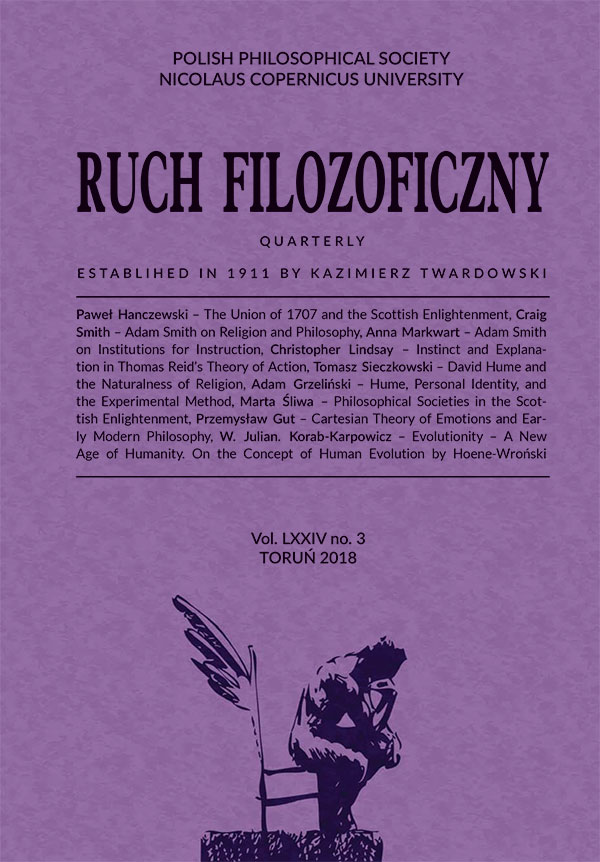
Instinct and Explanation in Thomas Reid’s Theory of Action
DOI:
https://doi.org/10.12775/RF.2018.027Keywords
Thomas Reid, agency, human nature, instinct, explanation, Scottish philosophyAbstract
In his account of what he calls the ‘mechanical principles’ of action, Thomas Reid distinguishes between deliberate, willed actions and those caused by instincts or habits. He holds that that agents can only be held morally responsible with respect to willed actions, as it is only in such cases that the agent acts freely on his libertarian model of agency. Nevertheless, in his later writings Reid seems to suggest that instinctual behaviour is both prior to and a precondition for the performance of free action. In this brief paper, I want to first introduce Reid’s theory of action and then expand upon this account in order to show that it goes some way to mitigate the criticisms raised by Louis Loeb and others against Reid, namely that Reid is content to rest with an account that rejects any attempt to explain the origin of beliefs that arise from human nature. Loeb portrays Hume as the superior philosopher due in part to his willingness to open up the black box of the mind for scientific inspection. I want to claim that Loeb misses the mark here; despite the fact that Hume does attempt to give us a psychological account of the origins of certain beliefs, it is crippled by the implausible restrictions Hume places on his system. Reid’s account, in contrast, employs a different conception of explanation and, as a result, offers a more plausible account that is not hindered by an unnecessary emphasis on introspection.
References
Broadie, Alexander. The Tradition of Scottish Philosophy. Edinburgh: Polygon, 1990.
Copenhaver, Rebecca. “Is Thomas Reid a Mysterian?” Journal of the History of Philosophy 44, no. 3 (January 2006): 449–466.
Ducheyne, Steffen. “Reid's adaptation and radicalization of Newton's natural philosophy,” History of European Ideas 32, (2006): 173–189.
Hampshire, Stuart. Thought and Action. London: Chatto and Windus, 1959.
Harris, James A. Of Liberty and Necessity: The Free Will Debate in Eighteenth-Century British Philosophy. Oxford: Oxford University Press, 2005.
Hume, David. A Treatise of Human Nature. 1739. Edition cited: L.A. Selby-Bigge and P.H. Nidditch (eds.), Oxford: Oxford University Press, 1978.
Laudan, Larry. “Thomas Reid and the Newtonian Turn of British Methodological Thought.” In R.E. Butts and J.W. Davis (eds.), The Methodological Heritage of Newton. Toronto: University of Toronto Press, 1970: 103–131.
Lindsay, Chris. “Hume and Reid on Naturalism, Liberty and Necessity.” In I. Kasavin, (ed.), David Hume and Contemporary Philosophy. Newcastle Upon Tyne: Cambridge Scholars Publishing, 2012.
Loeb, Louis. “The naturalisms of Hume and Reid.” Proceedings and Addresses of the APA 81, no. 2 (November 2007): 65–92.
Maddy, Penelope. “Naturalism and common sense.” Analytic Philosophy 52, no. 1 (2011): 2–34.
McDermid, Douglas. The Rise and Fall of Scottish Common Sense Realism. Oxford: Oxford University Press, 2018.
McMullin, Ernan. “The impact of Newton's Principia on the philosophy of science.” Philosophy of Science 68 (2001): 279–310.
Reid, Thomas. An Inquiry into the Human Mind on the Principles of Common Sense. 1764. Edition cited: D.R. Brookes (ed.), Edinburgh: Edinburgh University Press, 1997.
Reid, Thomas. Essays on the Intellectual Powers of Man. 1785. Edition cited: D. R. Brookes and K. Haakonssen (eds.), Edinburgh: Edinburgh University Press, 2002.
Reid, Thomas. Essays on the Active Powers of Man. 1788. Edition cited: K. Haakonssen and J.A. Harris (eds.), Edinburgh: Edinburgh University Press, 2010.
Reid, Thomas. “Of Power.” Philosophical Quarterly 51, no. 202 (January 2001): 1–12. (Written 1792).
Rowe, William L. “Thomas Reid's Theory of Freedom and Responsibility.” In T. Cuneo and R. van Woudenberg (eds.), The Cambridge Companion to Thomas Reid. Cambridge: Cambridge University Press, 2004.
Van Cleve, James. Problems from Reid. Oxford: Oxford University Press, 2015.
Wolterstorff, Nicholas. Thomas Reid and the Story of Epistemology. Cambridge: Cambridge University Press, 2001.
Wood, Paul. “Thomas Reid and the culture of science.” In T. Cuneo and R. van Woudenberg (eds.), The Cambridge Companion to Thomas Reid. Cambridge: Cambridge University Press, 2004.
Yaffe, Gideon. Manifest Activity: Thomas Reid’s Theory of Action. Oxford: Oxford University Press, 2004.
Downloads
Published
How to Cite
Issue
Section
Stats
Number of views and downloads: 777
Number of citations: 0


