Skip to main content Skip to main navigation menu Skip to site footer
  • Register
  • Login
  • Language
    • English
    • Język Polski
  • Menu
  • Home
  • Current
  • Archives
  • Announcements
  • About
    • About the Journal
    • Submissions
    • Editorial Team
    • Privacy Statement
    • Contact
  • Register
  • Login
  • Language:
  • English
  • Język Polski

Ruch Filozoficzny

Why Not Epistocracy?
  • Home
  • /
  • Why Not Epistocracy?
  1. Home /
  2. Archives /
  3. Vol. 73 No. 2 (2017) /
  4. Przekłady

Why Not Epistocracy?

Authors

  • David Estlund Brown University, Providence

DOI:

https://doi.org/10.12775/RF.2017.011

Keywords

epistocracy, political justification, epistemic democracy, scholocracy

Abstract

John Stuart Mill argued that the superior wisdom of an identifiable minority justified their having greater political authority. In particular, Mill thought, citizens with a high degree of education ought to have more votes than others, even if all ought to have the right to vote. My strategy is not the more familiar one of arguing that even though we must grant that the educated might rule more wisely, there are reasons of equal respect or procedural fairness that directly and decisively preclude giving some citizens more votes than others. I will not deny (nor accept) that the educated have the superior wisdom Mill’s argument supposes, but deny that such a claim is available as a justification for unequal political authority. In any case, my aim is as much to explain and acknowledge the challenge posed by Millean scholocracy as it is fully to answer it.
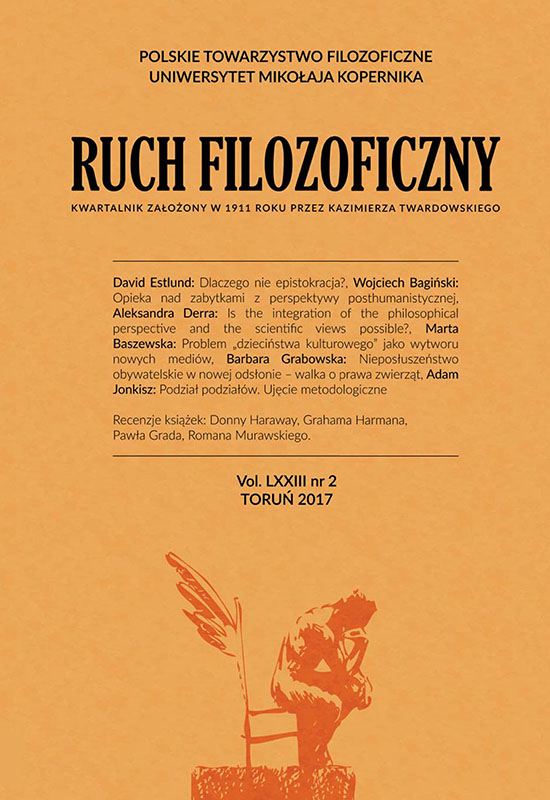
Ruch Filozoficzny

Downloads

  • PDF (Język Polski)

Published

2017-06-12

How to Cite

1.
ESTLUND, David. Why Not Epistocracy?. Ruch Filozoficzny. Online. 12 June 2017. Vol. 73, no. 2, pp. 7-25. [Accessed 1 November 2026]. DOI 10.12775/RF.2017.011.
  • ISO 690
  • ACM
  • ACS
  • APA
  • ABNT
  • Chicago
  • Harvard
  • IEEE
  • MLA
  • Turabian
  • Vancouver
Download Citation
  • Endnote/Zotero/Mendeley (RIS)
  • BibTeX

Issue

Vol. 73 No. 2 (2017)

Section

Przekłady

Stats

Number of views and downloads: 1682
Number of citations: 0

Search

Search

Browse

  • Issue archive

User

User

Current Issue

  • Atom logo
  • RSS2 logo
  • RSS1 logo

Information

  • For Readers
  • For Authors
  • For Librarians

Newsletter

Subscribe Unsubscribe

Language

  • English
  • Język Polski

Tags

Search using one of provided tags:

epistocracy, political justification, epistemic democracy, scholocracy
Up

Akademicka Platforma Czasopism

Najlepsze czasopisma naukowe i akademickie w jednym miejscu

apcz.umk.pl

Partners

  • Akademia Ignatianum w Krakowie
  • Akademickie Towarzystwo Andragogiczne
  • Fundacja Copernicus na rzecz Rozwoju Badań Naukowych
  • Instytut Historii im. Tadeusza Manteuffla Polskiej Akademii Nauk
  • Instytut Kultur Śródziemnomorskich i Orientalnych PAN
  • Instytut Tomistyczny
  • Karmelitański Instytut Duchowości w Krakowie
  • Ministerstwo Kultury i Dziedzictwa Narodowego
  • Państwowa Akademia Nauk Stosowanych w Krośnie
  • Państwowa Akademia Nauk Stosowanych we Włocławku
  • Państwowa Wyższa Szkoła Zawodowa im. Stanisława Pigonia w Krośnie
  • Polska Fundacja Przemysłu Kosmicznego
  • Polskie Towarzystwo Ekonomiczne
  • Polskie Towarzystwo Ludoznawcze
  • Towarzystwo Miłośników Torunia
  • Towarzystwo Naukowe w Toruniu
  • Uniwersytet im. Adama Mickiewicza w Poznaniu
  • Uniwersytet Komisji Edukacji Narodowej w Krakowie
  • Uniwersytet Mikołaja Kopernika
  • Uniwersytet w Białymstoku
  • Uniwersytet Warszawski
  • Wojewódzka Biblioteka Publiczna - Książnica Kopernikańska
  • Wyższe Seminarium Duchowne w Pelplinie / Wydawnictwo Diecezjalne „Bernardinum" w Pelplinie

© 2021- Nicolaus Copernicus University Accessibility statement Shop