Immanuel Kant as the Inspirer of Lazarus Bendavid’s Critique of Taste
DOI:
https://doi.org/10.12775/RF.2025.041Keywords
Immanuel Kant, Lazarus Bendavid, critique of taste, Kant’s aesthetics, Normalidee, philosophy of the Jewish Enlightenment (Haskalah)Abstract
The article examines the influence of Immanuel Kant’s aesthetics on Lazarus Bendavid’s Beiträge zur Kritik des Geschmacks (1797), authored by one of the most significant figures of the later Haskalah. The authors argue that Bendavid’s aesthetics is not merely a commentary on the Critique of the Power of Judgment, but rather an attempt to systematically extend Kant’s project and apply it within artistic and cultural practice. Drawing on Kant’s notion of the reflective power of judgment, Bendavid develops an account of aesthetic cognition centred on the concept of Normalidee—an intuitive norm that enables the comparative grasp of qualitative features and the assessment of relations between parts and wholes in a work of art. In doing so, he integrates a theory of sensible cognition with a theory of aesthetic judgment, thereby challenging Kant’s sharp separation between transcendental and empirical aesthetics.
The article also highlights the broader historical and intellectual context: Kant’s ambivalent attitude toward Judaism and the marginalization of Jewish philosophers in the reception of Kantianism. Against this background, Bendavid’s aesthetic theory emerges as an autonomous attempt to advance Kantian thought within the rationalist tradition of Jewish Enlightenment. The authors argue that Bendavid fills a gap left by Kant by constructing a practical aesthetics—an operational theory of aesthetic judgment that encompasses sensory qualities, mixed aesthetic values, and cultural context. As a result, Bendavid’s aesthetics becomes a complementary project to Kant’s, treating the aesthetic judgment not only as a condition for the possibility of experiencing beauty, but also as a tool for the concrete evaluation of artworks and perceptual experience.
References
Abrams Meyer Howard. 2003. Zwierciadło i lampa. Romantyczna teoria poezji a tradycja krytycznoliteracka, przeł. Maria Bożena Fedewicz. Gdańsk: Słowo/obraz/terytoria.
Allison Henry E. 2001. Kant's Theory of Taste. Cambridge: Cambridge University Press.
Pazura Stanisław. 1981. De gustibus. Rozważania nad dziejami pojęcia smaku estetycznego. Warszawa: PWN.
Bendavid Lazarus. 1794. Versuch über das Vergnügen. Wien: Stahel.
Bendavid Lazarus. 1796. Vorlesungen über die Kritik der Urtheilskraft. Wien: Stahel.
Bendavid Lazarus. 1797. Beiträge zur Kritik der Geschmack. Wien: Schaumburg und Compagnie.
Bendavid Lazarus. 1799. Versuch einer Geschmackslehre. Berlin: Belitz & Braun.
Bendavid Lazarus. 1802. Über den Ursprung unserer Erkenntniss. Berlin: Maurer.
Bitzan Amos. 2011. Disciplining the German Jewish Reading Revolution, 1770–1870. Berkeley: University of California.
Kant Immanuel. 2013. Dzieła zebrane. T. 2: Krytyka czystego rozumu, tłum. Mirosław Żelazny. Toruń: Wydawnictwo Naukowe UMK.
Kant Immanuel. 2014. Dzieła zebrane. T. 4: Krytyka władzy sądzenia, tłum. Mirosław Żelazny. Wydawnictwo Naukowe UMK.
Kant Immanuel. 2018. Korespondencja, tłum. Mirosław Żelazny. Toruń: Wydawnictwo Naukowe UMK.
Kaśkiewicz Kinga, Żelazny Mirosław, „Dwojaki sens Kantowskiego pojmowania wartości estetycznych”. W: Studia z Historii Filozofii, 2018, vol. 9, nr 4: 165-182.
Kayserling Dr. M. Don Ayrcs Vanz. 1865/66. „Lazarus Bendavid, eine biografische Skizze”, Jahrbuch für Israeliten. Wien: Schmid.
Koller Joseph. 1799. Entwurf zur Geschichte und Literatur der Aesthetik: von Baumgarten bis auf die neueste Zeit. Regensburg: Montag und Weiß.
Kozyra Wojciech. 2020. „Kant on the Jews and Their Religion”. Diametros 17 (65): 32–55.
Leibniz Gottfried Wilhelm. 1969. „Zasady natury i łaski oparte na rozumie”. W: Wyznanie wiary filozofa, tłum. Stanisław Cichowicz, 281-294.Warszawa: PWN.
Mendelssohn Moses. 1974. „Über das Erhabene und Naive”. W: Ästhetische Schriften in Auswahl, 153-240. Darmstadt: Wissenschaftliche Buchgesellschaft.
Ochman Jerzy. 2000. Filozofia oświecenia żydowskiego, Kraków, Universitas.
Rose Sven-Erik. 2014. “Off with Their Heads? Lazarus Bendavid’s Vision of Kantian Subjects at the End of Jewish History”. W: S. E. Rose, Jewish Philosophical Politics in Germany 1789–1848, 14-44. Waltham: Brandeis University Press.
Sauler Werner. 1982. „Bendavids Wiener Kants vorlesungen”. W: Österreichische Philosophie zwischen Aufklärung und Restauration, 25–45. Wien: Rodopi.
Strub Christian. 1989. „Das Häßliche und die Kritik der ästhetischen Urteilskraft. Übergang zu einer systematischen Lücke”. W: Kant-Studien 80 (1-4): 416–446.
Wallis Mieczysław. 2004. „Wartości estetyczne łagodne i ostre”. W: tenże, Wybór pism estetycznych, 65-98. Kraków: Wydawnictwo Literackie.
Weiner Benzion. 1927. Lazarus Bendavids Ästhetik und ihre geschichtliche Bedingtheit, Wien: https://services.phaidra.univie.ac.at/api/object/o:512007/preview (23.11.2015).
Żelazny Mirosław. 1994. Źródłowy sens pojęcia estetyka. Toruń: Wydawnictwo Naukowe UMK.
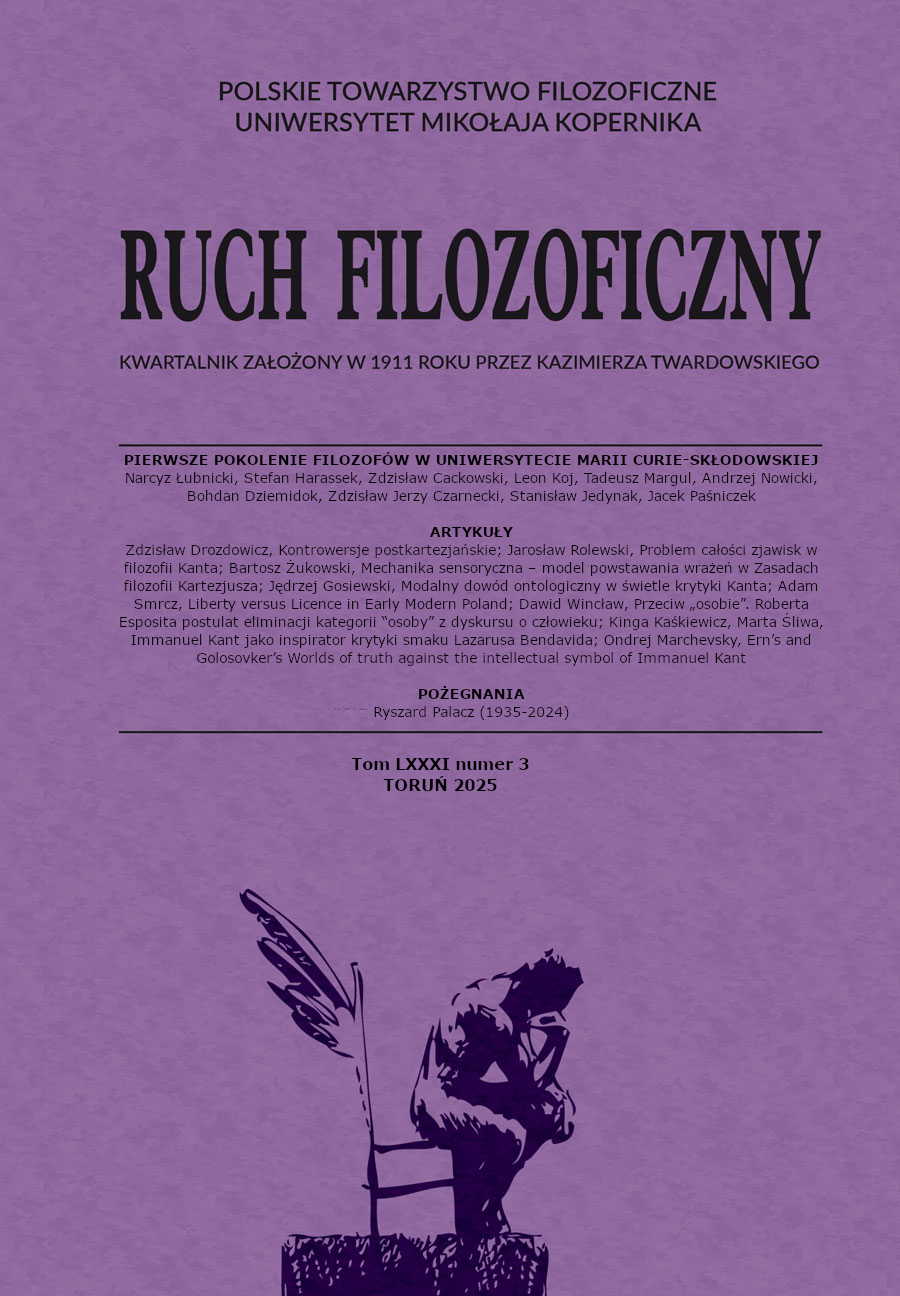
Downloads
Published
How to Cite
Issue
Section
License
Copyright (c) 2025 Kinga Kaśkiewicz, Marta Śliwa

This work is licensed under a Creative Commons Attribution-NoDerivatives 4.0 International License.
Stats
Number of views and downloads: 498
Number of citations: 0


