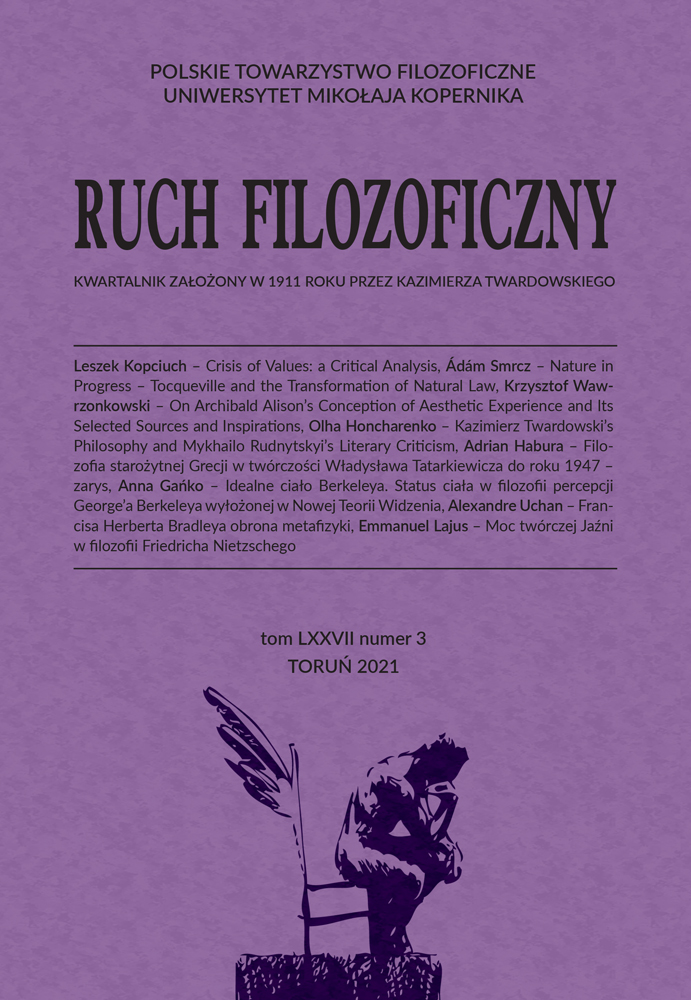
Berkeley’s Ideal Body. Status of the Body in George Berkeley’s Philosophy of Perception Presented in the New Theory of Vision
DOI:
https://doi.org/10.12775/RF.2021.028Keywords
philosophy of perception, sense cognition, body, ideas, experience, George Berkeley, New Theory of VisionAbstract
George Berkeley’s philosophy is a specific combination of idealism and empiricism. Berkeley is well known primarily for his view/theory/thesis that material objects do not exist. In the New Theory of Vision he presents a cognition process grounded in sensory perception, thus giving the senses a privileged role in cognition.
The article is an attempt to answer the question about the status of the body and corporeality in such process of cognition as in the context of Berkeley’s immaterialism. I propose such a reading of the Essay of the New Theory of Vision which does not focus on its content in the perspective of the later, Treatise on the Principles of Human Cognition which is considered to be the most important of Berkeley’s works. Instead, I look at those passages where Berkeley uses concepts related to the body and corporeality – primarily tactile ideas, which play a key role in the cognition process – to see how, according to Berkeley’s doctrine, the sensual body of the perceiving person is to be understood. In his mature doctrine, Berkeley admits the existence of only two kinds of entities: active minds and passive ideas. Therefore, the sensual body of the/a perceiving person must be classified as one of them. In the article, I argue that he could not have done otherwise than identify a perceiving body with an active mind.
References
Berkeley George. 1948–1957. The Works of George Berkeley Bishop of Cloyne. Edited by A. A. Luce and T. E. Jessop. Vol. I–IX. London-Edinburgh-Paris-Melbourne-Toronto-New York: Thomas Nelson and Sons.
Berkeley George. 2007. Dzienniki filozoficzne, przeł. Bartosz Żukowsk. Gdańsk: Wydawnictwo Słowo obraz/terytoria.
Berkeley George. 2011. Próba stworzenia nowej teorii widzenia i inne eseje filozoficzne, przeł. translatorium z filozofii angielskiej studium doktoranckiego Instytutu Filozofii UMK w Toruniu pod kierunkiem Adama Grzelińskiego. Toruń: Wydawnictwo Naukowe Uniwersytetu Mikołaja Kopernika.
Berkeley George. 1956. Traktat o zasadach poznania ludzkiego, przeł. Jerzy Leszczyński. Warszawa: Państwowe Wydawnictwo Naukowe.
Grzeliński Adam. 2010. Człowiek i duch nieskończony. Immaterializm George’a Berkeleya. Toruń: Wydawnictwo Naukowe Uniwersytetu Mikołaja Kopernika.
Hallett Harold. F. 1947. “Dr. Johnson's Refutation of Bishop Berkeley”. Mind 56, 222: 132–147.
Kopania Jerzy. 1990. „Semiotyka sensualizmu immanentnego. Idea, pojęcie i słowo w filozofii Berkeleya”. IDEA studia nad strukturą i rozwojem pojęć filozoficznych 3: 45–67.
Luce Arthur A. 1941. „Berkeley's Existence in the Mind”. Mind 50, 199: 258–267.
Luce Arthur A. 1940. „Development Within Berkeley's Commonplace Book”. Mind 49, 193: 42–51.
Mensch Jennifer. 2019. „Embodied Cognition in Berkeley and Kant: The Body’s Own Space”. W: Distributed Cognition in Enlightenment and Romantic Culture, ed. M. Anderson, G. Rousseau and M. Wheeler. 74–94. Edinburgh: Edinburgh University Press.
Spryszak Przemysław. 2004. Filozofia percepcji George’a Berkeleya. Kraków: Wydawnictwo Uniwersytetu Jagiellońskiego.
Szałek Piotr. K. 2016. Istnienie i umysł. Studium podstaw filozofii George’a Berkeleya. Kraków: Towarzystwo Autorów i Wydawców Prac Naukowych „Universitas”.
Szymańska-Lewoszewska Marta. 2014. „Miejsce teorii widzenia w filozofii Georga Berkeleya”. IDEA studia nad strukturą i rozwojem pojęć filozoficznych 26: 59–76.
Turbayne Colin M. 1959. „Berkeley’s Two Concepts of Mind”. Philosophy and Phenomenological Research 20, 1: 90–91.
White Alan R. 1954. „The ambiguity of Berkeley’s «without the mind»”. Hermathena 83: 55–65.
Wisdom John O. 1953. „An Outline of Berkeley’s Life”. The British Journal for the Philosophy of Science 4, 13: 78–87.
Downloads
Published
How to Cite
Issue
Section
License

This work is licensed under a Creative Commons Attribution-NoDerivatives 4.0 International License.
Stats
Number of views and downloads: 1097
Number of citations: 0


