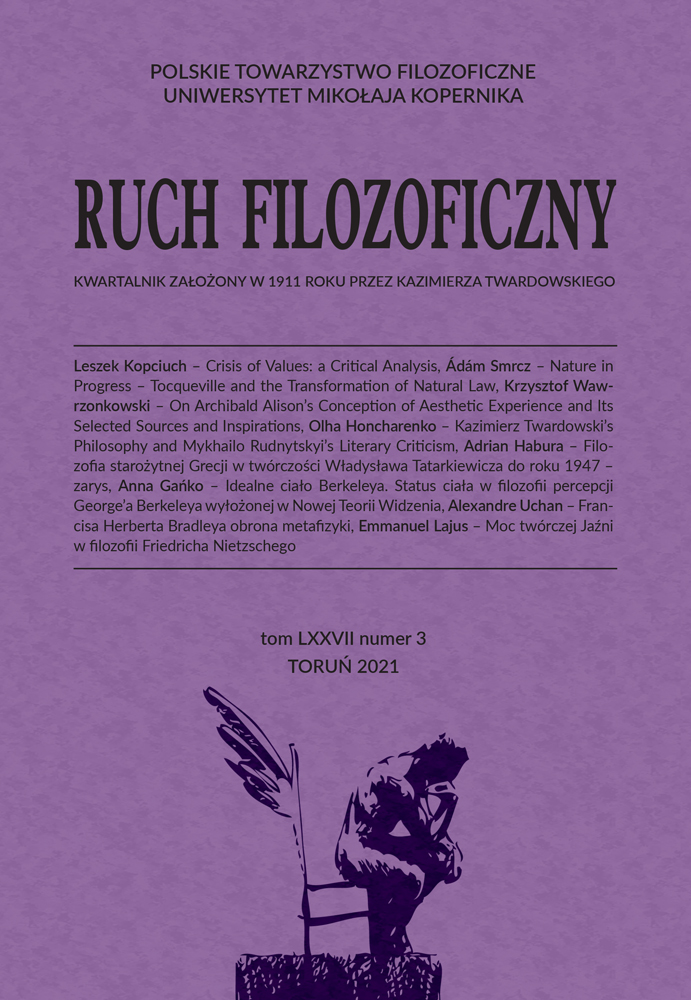
On Archibald Alison’s Conception of Aesthetic Experience and Its Selected Sources and Inspirations
DOI:
https://doi.org/10.12775/RF.2021.025Słowa kluczowe
Alexader Gerard, David Hume, Archibald Alison, Eighteenth-Century British aesthetics, taste, trains of ideas, trains of emotions, associationismAbstrakt
The present article is devoted to aesthetic experience as conceived by Archibald Alison. It reconstructs the associationist sources of his views in the form of selected issues from the aesthetics of D. Hume and A. Gerard. In the case of the former, three types of beauty and the general characteristics of experiencing them are recalled. In the case of the latter, a general view of the nature of aesthetic experience is presented, including the role of internal senses, feelings, their accumulation and associative relations. Alison’s conception of autonomous aesthetic experience is laid out based both on the first edition of his works and on subsequent editions, which include quite substantial revisions. Discussed in detail here are the issues of simple emotion and the aesthetic train of ideas, which together constitute an autonomous aesthetic experience. Also, the article provides an explanation of the difference between emotions of pleasure and emotions of taste. Moreover, it outlines the social resonance of aesthetic taste and its manifestations.
Bibliografia
Archibald Alison. 1790. Essays on The nature and Principles of Taste. Edinburgh: printed for J.J.G. and G. Robinson, London: Bell and Bradfute.
Archibald Alison. 1811. Essays on The nature and Principles of Taste, Vol I, Edinburgh; printed for Bell & Bradfute, and Arch. Constable and Co., London: F.C. and J. Rivington, and Constable, Hunter, Park, and Hunter.
Dickie George. 1996. The Century of Taste. The Philosophical Odyssey of Taste in the Eighteenth Century. Oxford, New York: Oxford University Press.
Gerard Alexander. 1780. An Essay on Taste to which is now added part fourth; with observation concerning the imitative nature of poetry. Edinburgh: J. Bell, and W. Creech; London: T. Cadell.
Guyer Paul. 2014. A History of Modern Aesthetics. Volume I: The Eighteenth Century. Cambridge: Cambridge University Press.
Hipple Walter. 1957. The Beautiful, the Sublime, and the Picturesque in Eighteenth – Century British Aesthetic Theory. Carbondale.
Hume David. 1896. A Treatise of Human Nature, reprinted from the original edition in three volumes and edited, with an analytical index, by L.A. Selby-Bigge. Oxford: The Clarendon Press.
Hume David. 1854. “An inquiry concerning human understanding”, in: David Hume, The Philosophical Works of David Hume. Including All The Essays, And Exhibiting The More Important Alterations And Corrections In The Successive Editions Published By The Author. In Four Volumes. Vol IV. Boston: Little, Brown And Company; Edinburgh: Adam And Charles Black.
Jauss Steven A. 2006. “Associationism and Taste Theory in Archibald Alison’s Essays”. The Journal of Aesthetics and Art Criticism 64, 4, 415-428.
Kivy Peter. 1976. The Seventh Sense. A Study of Francis Hutcheson`s Aesthetics And Its Influence in Eighteenth-Century Britain. New York: Burt Franklin & Co.
Monk Samuel. 1960. The Sublime: A Study of Critical Theories in XVIII-Century England. Michigan: Ann Arbor: University of Michigan Press.
Morawski Stefan. 1961. Studia z historii myśli estetycznej XVIII i XIX w. Warszawa: PWN.
Pazura Stanisław. 1981. De gustibus. Rozważania nad dziejami pojęcia smaku estetycznego. Warszawa: PWN.
Prus Bolesław. 1966. The Doll, translated by David Welsh, introduction St. Barańczak, Central European University Press.
Pobrania
Opublikowane
Jak cytować
Numer
Dział
Licencja

Utwór dostępny jest na licencji Creative Commons Uznanie autorstwa – Bez utworów zależnych 4.0 Międzynarodowe.
Statystyki
Liczba wyświetleń i pobrań: 1001
Liczba cytowań: 0


