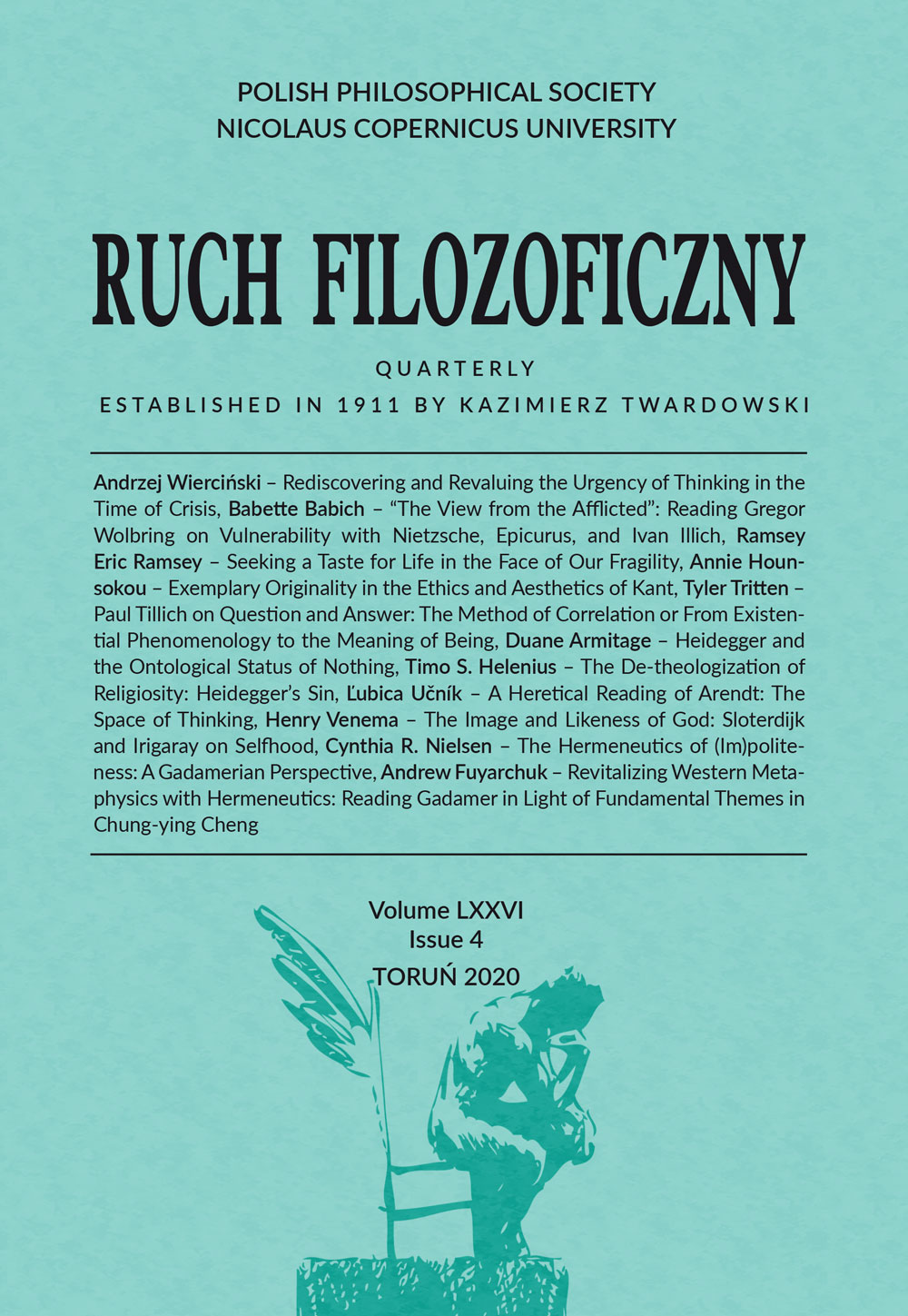
Exemplary Originality in the Ethics and Aesthetics of Kant: The Case of Naiveté
DOI:
https://doi.org/10.12775/33062Keywords
exemplary originality, genius, moral education, naïvetéAbstract
The following is an exploration of Kant’s use of the expression “exemplary originality” in his practical philosophy and in his aesthetics. In the Critique of Practical Reason and in Groundwork for the Metaphysics of Morals, Kant claims that there can be no exemplary originality in morality because (1) there is no way for us to know whether an act is really exemplary (2) it is not licit for us to imitate others, because we must always act from duty, i.e. from our own call to duty. In the Critique of Judgment, exemplary originality is what makes a work of art a standard to follow, i.e. a work of genius. After comparing and contrasting the two, I use the definition of the Critique of judgment to clarify the definition of Groundwork and the Critique of Practical Reason. I then examine the status of naiveté, a third, and puzzling, kind of exemplary originality.
References
Cervantes Miguel de. 1950. Don Quixote de la Mancha, transl. John Michael Cohen. London: Penguin Books.
Collingwood Robin George. 1938. Principles of Art. London: Oxford University Press.
Giesinger Johannes. 2012. “Kant’s Account of Moral Education”. Educational Philosophy and Theory 44, 7: 775–786.
Gould Timothy. 1982. “The Audience of Originality: Kant and Wordsworth on the Reception of the Genius”. In: Essays in Kant’s Aesthetics”, ed. Ted Cohen and Paul Guyer, 179–193. Chicago and London: University of Chicago Press.
Guyer Paul. 1983. “Autonomy and Integrity in Kant’s Aesthetics”. The Monist 66, 2: 167–188.
Guyer Paul. 2003. The Creation of Art: New Essays in Philosophical Aesthetics. Cambridge: Cambridge University Press.
Hounsokou Annie. 2012. “Exposing the Rogue in Us: an Exploration of Laughter in the Critique of Judgment”. Epoché: A Journal for the History of Philosophy 16, 2: 317–336.
Kant Immanuel. 1987. Critique of Judgment, transl. Werner Pluhar. Indianapolis: Hackett Publishing Company.
Kant Immanuel. 1993. Grounding for the Metaphysics of Morals, transl. James W. Ellington. Indianapolis: Hackett Publishing Company.
Lewis Peter. 1990. “Original Nonsense: Art and Genius in Kant’s Aesthetic”. In: Kant and his influence, ed. G. M. Ross and T. McWalter, 127–128. Bristol: Thoemmes.
Liu Yu. 2012. “Celebrating both Singularity and Commonality: The Exemplary Originality of the Kantian Genius”. International Philosophical Quarterly 52, 1: 99–116.
Makkreel Rudolf. 2002. “Reflections, Reflective Judgment and Aesthetic Exemplarity”. In: Aesthetics and cognition in Kant’s Critical Philosophy, ed. Rebecca Kukla, 223–244. West Nyack, NY: Cambridge University Press.
Melville Herman. 1967. Moby Dick. New York: Norton & Co.
Moran Kate. 2009. “Can Kant Have an Account of Moral Education?”. Journal of Philosophy of Education 43, 4: 471–484.
Munzel G. Felicitas. 2003. “Kant on Moral Education, or “Enlightenment” and the Liberal Arts”. The Review of Metaphysics 57, 1: 43–73.
Shakespeare William. 1972. King Lear. London: Penguin.
Timmerman Jens. 2007. Kant’s Groundwork of the Metaphysics of Morals. A Commentary. Cambridge: Cambridge University Press.
Velkley Richard. 2002. Being After Rousseau. Chicago: Chicago University Press.
Wood Robert E. 2001. “Kant’s ‘Antinomic’ Aesthetics”. American Catholic Philosophical Quarterly 75, 2: 271–295.
Downloads
How to Cite
Issue
Section
Stats
Number of views and downloads: 2470
Number of citations: 0


