Przejdź do sekcji głównej Przejdź do głównego menu Przejdź do stopki
  • Zarejestruj
  • Zaloguj
  • Język
    • Deutsch
    • English
    • Español (España)
    • Français (France)
    • Italiano
    • Język Polski
  • Menu
  • Strona domowa
  • Aktualny numer
  • Archiwum
  • O czasopiśmie
    • O czasopiśmie
    • Przesyłanie tekstów
    • Zespół redakcyjny
    • Polityka prywatności
    • Kontakt
  • Zarejestruj
  • Zaloguj
  • Język:
  • Deutsch
  • English
  • Español (España)
  • Français (France)
  • Italiano
  • Język Polski

Litteraria Copernicana

Retrouver la lumière: Métaphysique dans "Le Déluge" de JMG Le Clézio
  • Strona domowa
  • /
  • Retrouver la lumière: Métaphysique dans "Le Déluge" de JMG Le Clézio
  1. Strona domowa /
  2. Archiwum /
  3. Tom 34 Nr 2 (2020): Le Clézio /
  4. Studia i rozprawy

Retrouver la lumière: Métaphysique dans "Le Déluge" de JMG Le Clézio

Autor

  • Nicolas Pien Université de Caen-Normandie, France https://orcid.org/0000-0002-9638-9342

DOI:

https://doi.org/10.12775/LC.2020.024

Słowa kluczowe

Déluge, Saint-Augustin, Plotin, Vérité, Grâce

Abstrakt

Les premiers romans de Le Clézio sont traversés par la question métaphysique, dans une époque devenue athée. Fortement influencé par Saint-Augustin, et par Plotin, Le Déluge – dont le titre est le reflet de l’ambition “biblique” de l’auteur –, publié en 1966, fait état de la recherche d’une “vérité”, d’une lumière dans une réalité devenue “spectacle” et factice, recherche qui pose, in fine, la question de la grâce dans la société des “trente glorieuses” auscultée et dénoncée. Après avoir recherché, dans la ville, le mal contemporain – un monde d’artifices où le langage et la lumière se perdent –  Besson, le “héros”, si proche de Le Clézio, propose une façon d’aller vers un bien qu’il définit dans la dernière partie du roman. Il s’agira donc de confronter Le Déluge aux principes augustiniens afin de comprendre en quoi le texte envisage un itinéraire vers la grâce ou vers une forme de vérité et en quoi Le Clézio y définit aussi une mission de l’écriture et de l’écrivain au XXe siècle qui s’incarnera plus tard dans Désert (1980), par exemple.


In an era that has become atheistic, the metaphysical question is a fundamental aspect within the first novels by Le Clézio. Published in 1966 and strongly influenced by Saint Augustine, and by Plotinus, Le Déluge – its title being a reflection of the author's “biblical” ambition – , describes the search for a “truth”, for a light in a reality that has become an artificial “show”, a research that ultimately deals with the question of grace in the examined and denunciated society of the “Trente Glorieuses”. After having searched the city for contemporary evil, – the city, a world of artifices where language and light get lost - Besson, the “hero”, quite close to Le Clézio, offers a way to turn towards a good which he defines in the last part of the novel. It will therefore be a question of confronting Le Déluge with Augustinian principles in order to understand how the text envisages a route towards grace or towards a form of truth. Le Clézio also defines a mission to writing and to the writer of the XXth century which will be embodied later, for example in Désert (1980).

Bibliografia

Arendt, Hannah 1995. Le Concept d’amour chez Saint-Augustin. Paris: Rivages.

Deleuze, Gilles 1982. “Spinoza, cours n°10, du 17/01/1982”. http://www2.univ-paris8.fr/deleuze/article.php3?id_article=21 [09.11.2019].

Le Clézio, Jean-Marie Gustave 1963. Le Procès-verbal. Paris: Gallimard, coll. Le Chemin.

Le Clézio, Jean-Marie Gustave 1965. La Fièvre. Paris: Gallimard, coll. Le Chemin.

Le Clézio, Jean-Marie Gustave 1966. Le Déluge. Paris: Gallimard, coll. Le Chemin.

Le Clézio, Jean-Marie Gustave 1967. L’Extase matérielle. Paris: Gallimard, coll. Le Chemin.

Le Clézio, Jean-Marie Gustave 1971. Conversations avec Pierre Lhoste. Paris: Mercure de France.

Paul de Tharse, 2008. Epîtres de Saint-Paul: traduction officielle. Paris : Desclée de Brouwer.

Saint-Augustin, 1998–2002. Œuvres. Paris: Gallimard, coll. La Pléiade.
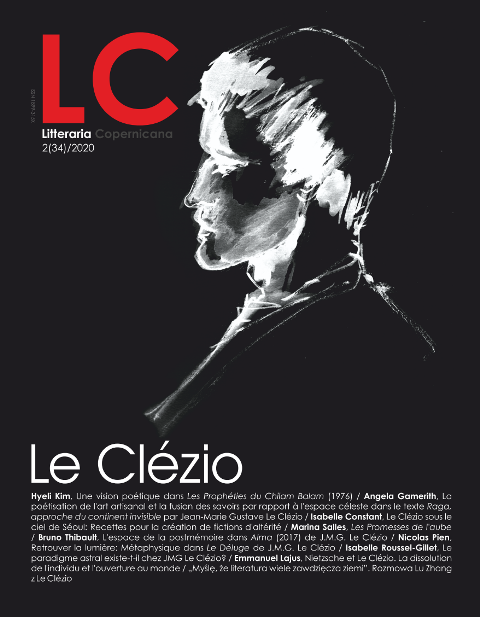
Litteraria Copernicana

Pobrania

  • PDF (Français (France))

Opublikowane

2020-06-30

Jak cytować

1.
PIEN, Nicolas. Retrouver la lumière: Métaphysique dans "Le Déluge" de JMG Le Clézio. Litteraria Copernicana [online]. 30 czerwiec 2020, T. 34, nr 2, s. 69–80. [udostępniono 19.2.2026]. DOI 10.12775/LC.2020.024.
  • PN-ISO 690 (Polski)
  • ACM
  • ACS
  • APA
  • ABNT
  • Chicago
  • Harvard
  • IEEE
  • MLA
  • Turabian
  • Vancouver
Pobierz cytowania
  • Endnote/Zotero/Mendeley (RIS)
  • BibTeX

Numer

Tom 34 Nr 2 (2020): Le Clézio

Dział

Studia i rozprawy

Statystyki

Liczba wyświetleń i pobrań: 695
Liczba cytowań: 0

Wyszukiwanie

Wyszukiwanie

Przeglądaj

  • Indeks autorów
  • Lista archiwalnych numerów

Użytkownik

Użytkownik

Aktualny numer

  • Logo Atom
  • Logo RSS2
  • Logo RSS1

Informacje

  • dla czytelników
  • dla autorów
  • dla bibliotekarzy

Newsletter

Zapisz się Wypisz się

Język / Language

  • Deutsch
  • English
  • Español (España)
  • Français (France)
  • Italiano
  • Język Polski

Tagi

Szukaj przy pomocy tagu:

Déluge, Saint-Augustin, Plotin, Vérité, Grâce
W górę

Akademicka Platforma Czasopism

Najlepsze czasopisma naukowe i akademickie w jednym miejscu

apcz.umk.pl

Partnerzy platformy czasopism

  • Akademia Ignatianum w Krakowie
  • Akademickie Towarzystwo Andragogiczne
  • Fundacja Copernicus na rzecz Rozwoju Badań Naukowych
  • Instytut Historii im. Tadeusza Manteuffla Polskiej Akademii Nauk
  • Instytut Kultur Śródziemnomorskich i Orientalnych PAN
  • Instytut Tomistyczny
  • Karmelitański Instytut Duchowości w Krakowie
  • Ministerstwo Kultury i Dziedzictwa Narodowego
  • Państwowa Akademia Nauk Stosowanych w Krośnie
  • Państwowa Akademia Nauk Stosowanych we Włocławku
  • Państwowa Wyższa Szkoła Zawodowa im. Stanisława Pigonia w Krośnie
  • Polska Fundacja Przemysłu Kosmicznego
  • Polskie Towarzystwo Ekonomiczne
  • Polskie Towarzystwo Ludoznawcze
  • Towarzystwo Miłośników Torunia
  • Towarzystwo Naukowe w Toruniu
  • Uniwersytet im. Adama Mickiewicza w Poznaniu
  • Uniwersytet Komisji Edukacji Narodowej w Krakowie
  • Uniwersytet Mikołaja Kopernika
  • Uniwersytet w Białymstoku
  • Uniwersytet Warszawski
  • Wojewódzka Biblioteka Publiczna - Książnica Kopernikańska
  • Wyższe Seminarium Duchowne w Pelplinie / Wydawnictwo Diecezjalne „Bernardinum" w Pelplinie

© 2021- Uniwersytet Mikołaja Kopernika w Toruniu Deklaracja dostępności Sklep wydawnictwa