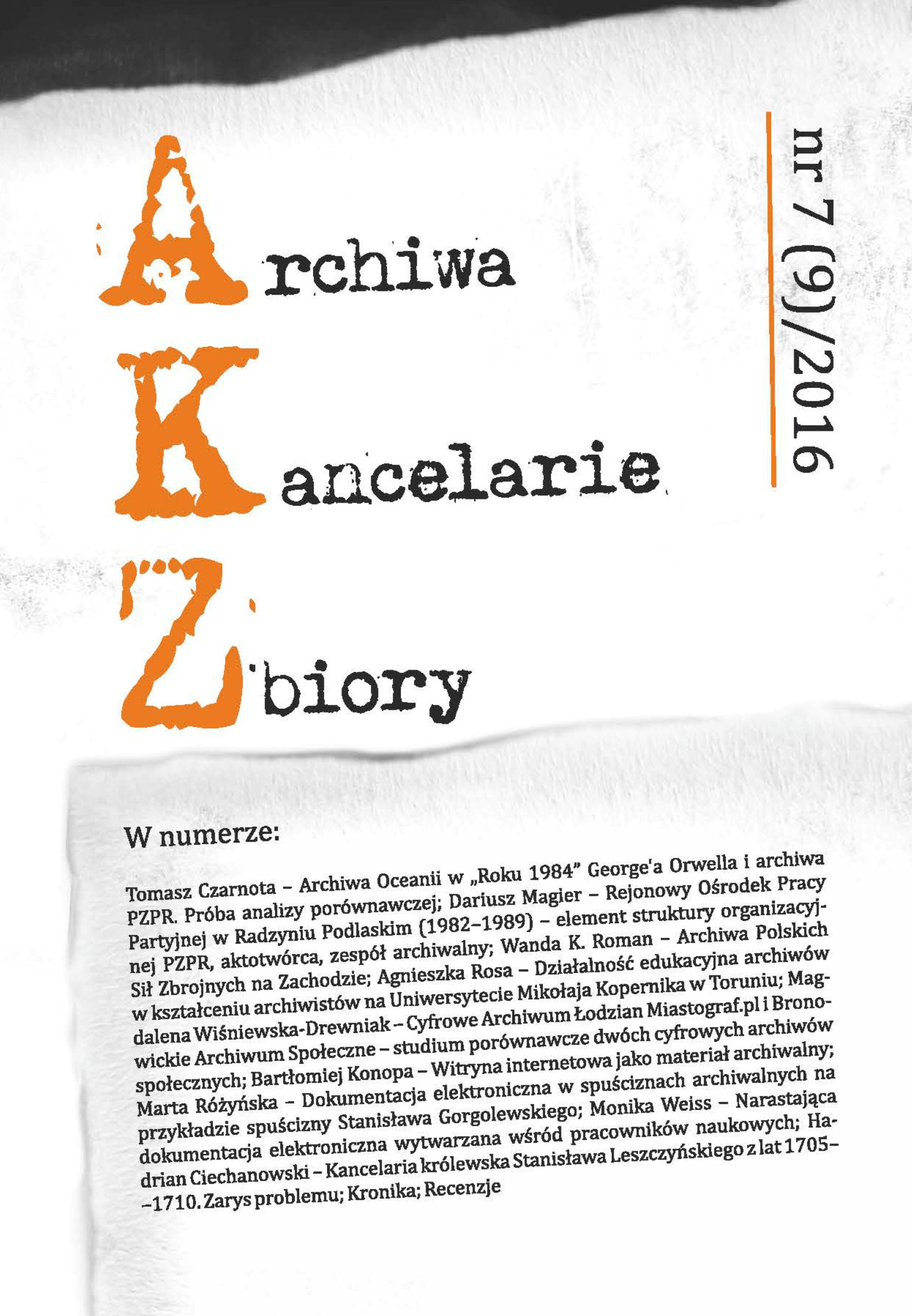
Archives of Oceania in George Orwell’s Nineteen Eighty-Four and archives of the Polish United Workers’ Party. An attempt of comparative analysis
DOI:
https://doi.org/10.12775/AKZ.2016.001Keywords
military archives, PAF archives, archives during World War 2Abstract
Similarities between totalitarian state Oceania ruled by the Party in Nineteen Eighty-Four to communist rule in Europe and outside of it provoke comparisons. They enable to obtain additional knowledge not only about the book, but also about the system; so it is in the case of my article. In this article I concentrated on the issue of archives and, partly, past and history, illustrated by information from the G. Orwell’s book and archival materials of the Polish United Workers' Party. In Oceania the past was a changing category as a result of full control of all elements linking it to the present (press, books, documents etc.), which led to strengthening the Party’s rule. Documents stored in archives were constantly swapped, so they conform what the Party was claiming at the time. In that situation access to the fabricated studies and sources must have been free. But objective historiography could not exist, even if “historical” books were published. In turn, for the PUWP that ruled in Poland, accomplishments of the party and its predecessors were important for the ideology and legitimizing its authority. The party discerned the
benefits of initiating historical research (not necessarily fully objective) and preserving authentic documents in its archives, which could be used in the research and propaganda. But the holdings of the party’s archives were not accessible for everyone. For example, documents depicting “not progressive” phenomena were rationed. Comparing approach to this issue of the Oceanian Party and of the PUWP shows, that they actually had completely different visions and ways of acting. It leads to a conclusion, that the PUWP hardly resembled similar strands described by G. Orwell, looking on the archival issues.
References
Ciechanowski H., Archiwum jako miejsce zapomnienia, [w:] Toruńskie Konfrontacje Archiwalne, t. 4: Nowa archiwistyka - archiwa i archiwistyka w ponowoczesnym kontekście kulturowym, red. W. Chorążyczewski, W. Piasek i A. Rosa, Toruń 2014.
Grygier T., Współczesne zadania dokumentacyjne archiwów, "Archiwa, Biblioteki i Muzea Kościelne” 1980, t. 40.
Grygier T., Współczesne zadania dokumentacyjne archiwów (II), "Archiwa, Biblioteki i Muzea Kościelne” 1980, t. 41.
Grygier T., Współczesne zadania dokumentacyjne archiwów (III), "Archiwa, Biblioteki i Muzea Kościelne” 1981, t. 42.
Hlebionek M., Praecipum archivi effectus est probatio ac fides rei gesta publica. Krytyka autentyczności i wiarygodności materiałów archiwalnych w najstarszych traktatach archiwistycznych, [w:] Silva rerum opera historica, diplomatica et archivistica continens, Andreae Tomczak dedicata, red. W. Chorążyczewski, M. Hlebionek, Toruń - Warszawa 2012.
Kołomejczyk N., Wojewódzkie archiwa PZPR, "Archiwa Polskiej Zjednoczonej Partii Robotniczej. Biuletyn” 1981, nr 1.
Leszkowicz T., Ostatnia ofensywa na froncie historycznym? Polityka pamięci historycznej Polskiej Zjednoczonej Partii Robotniczej w latach 1981-1986, "Dzieje Najnowsze” 2014, R. 16, nr 2.
Rutkowski T. P., Tworzenie zrębów mitu. Działalność Wydziału Historii Partii Komitetu Centralnego Polskiej Partii Robotniczej na polu propagandy dziejów ruchu robotniczego, [w:] Polska Partia Robotnicza 1944-1948. Studia i szkice, red. M. Krzysztofiński, Rzeszów 2014.
Ryszewski B., Problemy i metody badawcze archiwistyki, Toruń 1985.
Downloads
Published
How to Cite
Issue
Section
Stats
Number of views and downloads: 733
Number of citations: 0


