Przejdź do sekcji głównej Przejdź do głównego menu Przejdź do stopki
  • Zarejestruj
  • Zaloguj
  • Język
    • English
    • Język Polski
  • Menu
  • Strona domowa
  • Aktualny numer
  • Archiwum
  • Ogłoszenia
  • O czasopiśmie
    • O czasopiśmie
    • Przesyłanie tekstów
    • Zespół redakcyjny
    • Polityka prywatności
    • Kontakt
  • Zarejestruj
  • Zaloguj
  • Język:
  • English
  • Język Polski

Ruch Filozoficzny

No True Scotsman Disregards the Enlightenment. Alasdair MacIntyre’s Critique of the Enlightenment Project
  • Strona domowa
  • /
  • No True Scotsman Disregards the Enlightenment. Alasdair MacIntyre’s Critique of the Enlightenment Project
  1. Strona domowa /
  2. Archiwum /
  3. Tom 75 Nr 4 (2019) /
  4. Articles - British Modern Philosophy

No True Scotsman Disregards the Enlightenment. Alasdair MacIntyre’s Critique of the Enlightenment Project

Autor

  • Agnieszka Sztajer The John Paul II Catholic University of Lublin, Lublin https://orcid.org/0000-0002-4414-6226

DOI:

https://doi.org/10.12775/RF.2019.060

Słowa kluczowe

Enlightenment, MacIntyre, ethics, virtues, conservatism

Abstrakt

Alasdair MacIntyre, being one of the most notorious critics of the Enlightenment project, does not deny good intentions of those who created values of what we today call the Enlightenment project. Criticising emotivism that stems from the values of the Enlightenment project, he does not claim that the Enlightenment itself destroyed European culture of ethics or that it intended to turn the way of thinking about ethics upside down. Yet, MacIntyre claims that moral philosophy before the Enlightenment and after it are two distinctive systems, the second one being in a constant process of corrupting.

What is the most important in the paper is showing that for MacIntyre, the Enlightenment project was an attempt to justify traditional European morality, but it was a failed attempt. It was because the universe as a unified structure perceived by a human as such became partitioned and knowledge of it divided into many disciplined. This disintegration, reinforced by the Enlightenment, is the very core of anything that Alasdair MacIntyre ever sees as a vice in moral philosophising.

Bibliografia

Barnett Samuel. 2003. The Enlightenment and Religion. The Myths of Modernity. Manchester: University Press.

Brown Stuart (ed.). 1996. British Philosophy and the Age of Enlightenment. Abingdon: Routledge.

Gay Peter. 1995. The Enlightenment. An interpretation. The rise of Modern Paganism. New York: W. W Norton & Company.

Israel Jonathan. 2002. Radical Enlightenment. Oxford: Oxford University Press.

Jacobs Margaret. 2003. Radical Enlightenment. Greensboro: The Temple Publishers.

Louden Robert. 2011. Kant’s Human Being. Essays on His Theory of Human Nature. Oxford: Oxford University Press.

Lutz Christopher. 2012. Reading Alasdair MacIntyre’s After Virtue. New York: Continuum.

MacIntyre Alasdair. 1981. After Virtue. A Study in Moral Theory. University of Notre Dame Press.

MacIntyre Alasdair. 1988. Whose Justice? Which Rationality? University of Notre Dame Press.

MacIntyre Alasdair. 1966. A Short History of Ethics. MacMillan.

MacIntyre Alasdair. 1994. Three Rival Versions of Moral Inquiry. Notre-Dame, Indiana: University of Notre Dame Press.

Nowak Witold. 2018. Spór o nowoczesność w poglądach Charlesa Taylora i Alasdaira MacIntyre’a. Rzeszów: Wydawnictwo Uniwersytetu Rzeszowskiego.

Obinyan Valentine Ehichioya. 2014. “Nature of Human Existence in Kierkegaard’s Ethical Philosophy: A Step towards Self-Valuation and Transformation in Our Contemporary World”. International Journal of Philosophy 1, 2: 1–14.

Taylor Charles. 1992. Sources of the Self: The Making of The Modern Identity. Cambridge, Massachusetts: Harvard University Press.

Zatorski Tadeusz. 2010. “Od tłumacza”. In: Cassirer Ernst, Filozofia Oświecenia, przeł. T. Zatorski. Warszawa: Wydawnictwo UW.
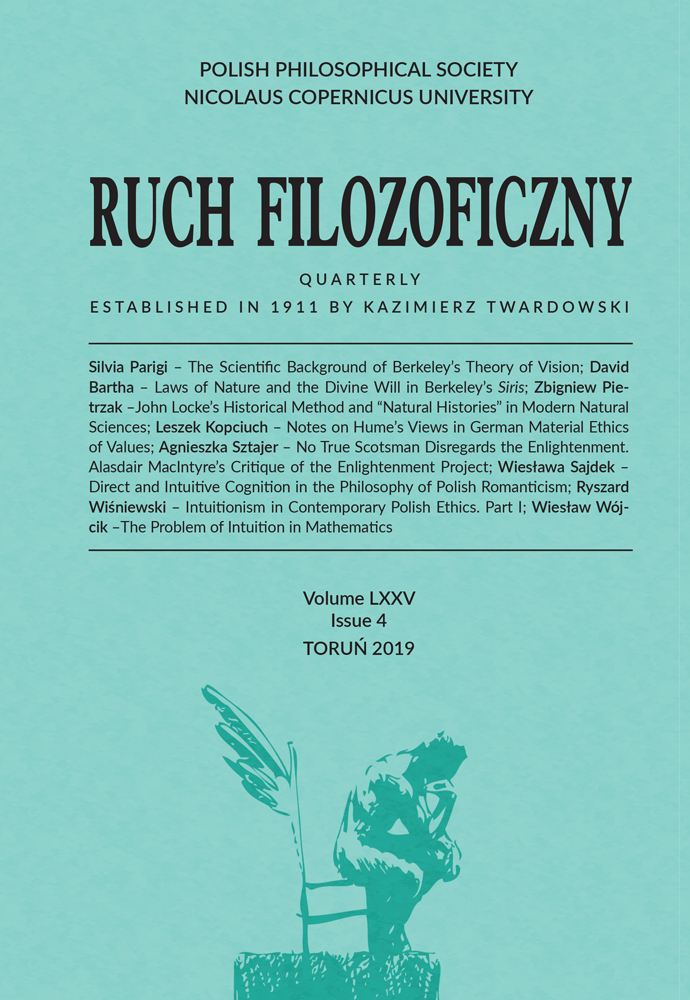
Ruch Filozoficzny

Pobrania

  • PDF (English)

Opublikowane

2020-01-15

Jak cytować

1.
SZTAJER, Agnieszka. No True Scotsman Disregards the Enlightenment. Alasdair MacIntyre’s Critique of the Enlightenment Project. Ruch Filozoficzny [online]. 15 styczeń 2020, T. 75, nr 4, s. 95–108. [udostępniono 12.8.2026]. DOI 10.12775/RF.2019.060.
  • PN-ISO 690 (Polski)
  • ACM
  • ACS
  • APA
  • ABNT
  • Chicago
  • Harvard
  • IEEE
  • MLA
  • Turabian
  • Vancouver
Pobierz cytowania
  • Endnote/Zotero/Mendeley (RIS)
  • BibTeX

Numer

Tom 75 Nr 4 (2019)

Dział

Articles - British Modern Philosophy

Statystyki

Liczba wyświetleń i pobrań: 1367
Liczba cytowań: 0

Wyszukiwanie

Wyszukiwanie

Przeglądaj

  • Indeks autorów
  • Lista archiwalnych numerów

Użytkownik

Użytkownik

Aktualny numer

  • Logo Atom
  • Logo RSS2
  • Logo RSS1

Informacje

  • dla czytelników
  • dla autorów
  • dla bibliotekarzy

Newsletter

Zapisz się Wypisz się

Język / Language

  • English
  • Język Polski

Tagi

Szukaj przy pomocy tagu:

Enlightenment, MacIntyre, ethics, virtues, conservatism
W górę

Akademicka Platforma Czasopism

Najlepsze czasopisma naukowe i akademickie w jednym miejscu

apcz.umk.pl

Partnerzy platformy czasopism

  • Akademia Ignatianum w Krakowie
  • Akademickie Towarzystwo Andragogiczne
  • Fundacja Copernicus na rzecz Rozwoju Badań Naukowych
  • Instytut Historii im. Tadeusza Manteuffla Polskiej Akademii Nauk
  • Instytut Kultur Śródziemnomorskich i Orientalnych PAN
  • Instytut Tomistyczny
  • Karmelitański Instytut Duchowości w Krakowie
  • Ministerstwo Kultury i Dziedzictwa Narodowego
  • Państwowa Akademia Nauk Stosowanych w Krośnie
  • Państwowa Akademia Nauk Stosowanych we Włocławku
  • Państwowa Wyższa Szkoła Zawodowa im. Stanisława Pigonia w Krośnie
  • Polska Fundacja Przemysłu Kosmicznego
  • Polskie Towarzystwo Ekonomiczne
  • Polskie Towarzystwo Ludoznawcze
  • Towarzystwo Miłośników Torunia
  • Towarzystwo Naukowe w Toruniu
  • Uniwersytet im. Adama Mickiewicza w Poznaniu
  • Uniwersytet Komisji Edukacji Narodowej w Krakowie
  • Uniwersytet Mikołaja Kopernika
  • Uniwersytet w Białymstoku
  • Uniwersytet Warszawski
  • Wojewódzka Biblioteka Publiczna - Książnica Kopernikańska
  • Wyższe Seminarium Duchowne w Pelplinie / Wydawnictwo Diecezjalne „Bernardinum" w Pelplinie

© 2021- Uniwersytet Mikołaja Kopernika w Toruniu Deklaracja dostępności Sklep wydawnictwa