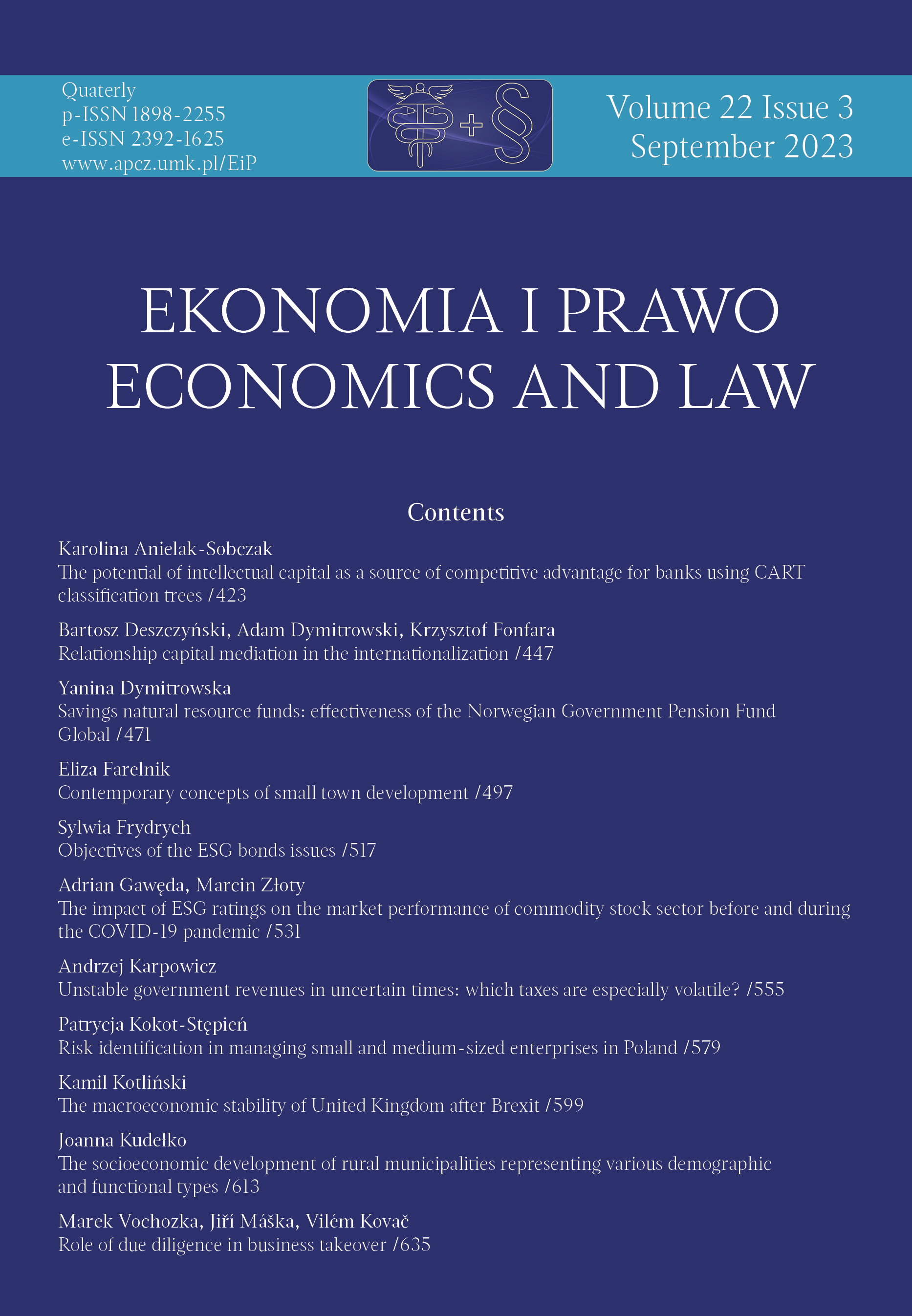
The impact of ESG ratings on the market performance of commodity stock sector before and during the COVID-19 pandemic
DOI:
https://doi.org/10.12775/EiP.2023.029Keywords
commodity companies, ESG, stock exchangeAbstract
Motivation: The growing importance of ESG in the international economy makes the analysed issues extremely interesting. More and more studies show the growing role of ESG performance on company financial and market results as well as analyse the impact of the COVID-19 pandemic on the financial market. The study of rate of return and the relationship between the largest company companies in European Union Member States is of key importance considering the investment portfolio risk.
Aim: The main aim of the article is impact assessment of ESG performance of the firm (proxied by ESG scoring by Refinitiv) on the rate of return of commodity sector companies listed on financial markets of European Union Member States. The second goal of the paper is to determine the impact of the COVID-19 pandemic on the rate of return of the analysed companies. The third and final goal is to assess the impact of sector leader status on the rate of return of these companies (i.e. KGHM, PKN Orlen, Royal Dutch Shell and Rio Tinto).
Results: ESG disclosure by the surveyed companies and ESG scoring had negative impact on the rate of return, while E, S and G scorings did not affect rate of return at all. Sector leaders were less negatively impacted by the COVID-19 economic crisis than the rest of the sector, however sector leadership status was not statistically significant. COVID-19 pandemic positively influenced the rate of return of analysed companies. In case of commodities stock companies, the economic crisis caused by the pandemic brought about higher levels of uncertainty in the financial markets.
References
Ahlström, H., & Monciardini, D. (2021). The regulatory dynamics of sustainable finance: paradoxical success and limitations of EU reforms. Journal of Business Ethics, 177, 193–212. https://doi.org/10.1007/s10551-021-04763-x.
Amel-Zadeh, A., & Serafeim, G. (2018). Why and how investors use ESG information: evidence from a global survey. Financial Analysts Journal, 74, 87–103. https://doi.org/10.2469/faj.v74.n3.2.
Arora, S., Sur, J.K., & Chauhan, Y. (2021). Does corporate social responsibility affect shareholder value: evidence from the COVID-19 crisis. International Review of Finance, 22(2), 325–334. https://doi.org/10.1111/irfi.12353.
Bajic, S., & Yurtoglu, B.B. (2018). CSR, market value, and profitability: international evidence. In S. Boubaker, D. Cumming, & D.C. Nguyen (Ed.), Research handbook of finance and sustainability (pp. 29–53). Edward Elgar.
Belitski, M., Guenther, C., Kritikos, A., & Thurik R. (2022). Economic effects of the COVID 19 pandemic on entrepreneurship and small businesses. Small Business Economics, 58, 593–609. https://doi.org/10.1007/s11187-021-00544-y.
Brammer, S., Brooks, C., & Pavelin S. (2006). Corporate social performance and stock returns: UK evidence from disaggregate measures. Financial Management, 35(3), 97–116. https://doi.org/10.1111/j.1755-053X.2006.tb00149.x.
Chollet, P., & Sandwidi, B.W. (2018). CSR engagement and financial risk: a virtuous circle. International evidence. Global Finance Journal, 38, 65–71. https://doi.org/10.1016/j.gfj.2018.03.004.
Clemente-Suárez, V., Navarro-Jiménez, E., Moreno-Luna, M., Saavedra-Serrano, L., Jimenez, M., Antonio Simón, J., & Tornero-Aguilera, J.,(2021). The impact of the COVID-19 pandemic on social, health and economy. Sustainability, 13(11), 6314. https://doi.org/10.3390/su13116314.
Directive 2014/95/EU of the European Parliament and of the Council of 22 October 2014 amending Directive 2013/34/EU as regards disclosure of non-financial and diversity information by certain large undertakings and groups (OJ L 330, 15.11.2014).
Dowell, G., Hart, S., & Yeung, B. (2000). Do corporate global environmental standards create or destroy market value. Management Science, 46(8), 1059–1074.
Durand, R.B., Koh, S., & Limkriangkrai, M. (2013). Saints versus sinners: does morality matter. Journal of International Financial Markets, Institutions & Money, 24, 166–183. https://doi.org/10.1016/j.intfin.2012.12.002.
Escrig-Olmedo, E., Muñoz-Torres, M.J., & Fernández-Izquierdo, M.Á. (2010). Socially responsible investing: sustainability indices, ESG rating and information provider agencies. International Journal of Sustainable Economy, 2(4), 442–461. https://doi.org/10.1504/ijse.2010.035490.
Fatemi, A., Glaum, M., & Kaiser S. (2018). ESG performance and firm value: the moderating role of disclosure. Global Finance Journal, 38, 45–64. https://doi.org/10.1016/j.gfj.2017.03.001.
Folger-Laronde, Z., Pashang, S., Feor, L., Alfy, E.A. (2020). ESG ratings and financial performance of exchange-traded funds during the COVID-19 pandemic. Journal of Sustainable Finance and Investment, 12(2), 490–496. https://doi.org/10.1080/20430795.2020.1782814.
Friede, G., Busch, T., & Bassen, A. (2015). ESG and financial performance: aggregated evidence from more than 2000 empirical studies. Journal of Sustainable Finance & Investment, 5(4), 210–233. https://doi.org/10.1080/20430795.2015.1118917.
Gawęda, A. (2021). Sustainability reporting: case of European stock companies. European Journal of Sustainable Development, 10(4), 41–53. https://doi.org/10.14207/ejsd.2021.v10n4p41.
Gillan, S., Koch, A., & Starks, L. (2021). Firms and social responsibility: a review of ESG and CSR research in corporate finance. Journal of Corporate Finance, 66, 101889. https://doi.org/10.1016/j.jcorpfin.2021.101889.
Grygiel-Tomaszewska, A., & Turek, J. (2021). The role of ESG in default early warning. Kwartalnik Nauk o Przedsiębiorstwie, 62(5), 25–39. https://doi.org/10.33119/KNoP.2021.62.5.3.
Halbritter, G., & Dorfleitner, G. (2015). The wages of social responsibility: where are they: a critical review of ESG investing. Review of Financial Economics, 26(1), 25–35. https://doi.org/10.1016/j.rfe.2015.03.004.
Huber, B.M., & Comstock, M. (2017). ESG reports and ratings: what they are, why they matter: oversight role: a practical guide. The Corporate Governance Advisor, 25(5), 1–12.
Jensen, M.C. (2001). Value maximization, stakeholder theory, and the corporate objective function. Journal of Applied Corporate Finance, 14(3), 8–21. https://doi.org/10.1111/j.1745-6622.2001.tb00434.x.
KGHM. (2023). Retrieved 15.06.2023 from https://kghm.com.
Khan, M.A. (2022). ESG disclosure and firm performance: a bibliometric and meta analysis. Research in International Business and Finance, 6, 101668. https://doi.org/10.1016/j.ribaf.2022.101668.
Lang, L., & Stulz, R. (1994). Tobin’s Q, corporate diversification, and firm performance. Journal of Political Economy, 102(6), 1248–1280. http://dx.doi.org/10.1086/261970.
Lo, S.-F., & Sheu H.-J. (2007). Is corporate sustainability a value-increasing strategy for business. Corporate Governance: An International Review, 15(2), 345–358. https://doi.org/10.1111/j.1467-8683.2007.00565.x.
Lueg, K., Krastev, B., & Lueg, R. (2019). Bidirectional effects between organizational sustainability disclosure and risk. Journal of Cleaner Production, 229, 268–277. https://doi.org/10.1016/j.jclepro.2019.04.379.
Matos, P.V., Barros, V., & Sarmento, J.M. (2020). Does ESG affect the stability of dividend policies in Europe. Sustainability, 12(21), 8804. https://doi.org/10.3390/su12218804.
Mayer, B. (2022). The duty of care of fossil-fuel producers for climate change mitigation: Milieudefensie v. Royal Dutch Shell District Court of The Hague (The Netherlands). Transnational Environmental Law, 11(2), 407–418. https://doi.org/10.1017/S2047102522000103.
McLean, R.D., Zhang, T., & Zhao, M. (2012). Why does the law matter: investor protection and its effects on investment, finance, and growth. The Journal of Finance, 67(1), 313–350. https://doi.org/10.1111/j.1540-6261.2011.01713.x.
Mihalajmeno, M.O. (2015). Credit rating agency performance in terms of profit. Procedia Economics and Finance, 30, 631–642. https://doi.org/10.1016/S2212-5671(15)01276-9.
Orlen. (2023). Retrieved 15.06.2023 from https://orlen.pl.
Pástor, L., & Vorsatz, M.B. (2020). Mutual fund performance and flows during the COVID-19 Crisis. The Review of Asset Pricing Studies, 10(4), 791–833. https://doi.org/10.1093/rapstu/raaa015.
Refinitiv. (2022). Environmental, social and governance scores from Refinitiv. Retrieved 15.06.2023 from https://www.refinitiv.com/content/dam/marketing/en_us/documents/methodology/refinitiv-esg-scores-methodology.pdf.
RobecoSAM. (2023). ESG definition. Retrieved 15.06.2023 from https://www.robeco.com/en-int/glossary/sustainable-investing/esg-definition.
Royal Dutch Shell. (2023). Retrieved 15.06.2023 from https://shell.pl.
Rozek, N., & McQuinn, B. (2021). Saudi Arabia’s currency misalignment and international competitiveness, accounting for geopolitical risks and the super-contango oil market. Resources Policy, 72, 102057. https://doi.org/10.1016/j.resourpol.2021.102057.
Schoenmaker, D., & Schramade, W. (2019). Principles of sustainable finance. Oxford University Press.
Sia-Partners. (2021). ESG data market: changes and challenges for financial services players. Retrieved 15.06.2023 from https://www.sia-partners.com/en/insights/publications/esg-data-market-changes-and-challenges-financial-players.
Stellner, C., Klein, C., & Zwergel, B. (2015). Corporate social responsibility and Eurozone corporate bonds: the moderating role of country sustainability. Journal of Banking Finance, 59, 538–549. https://doi.org/10.1016/j.jbankfin.2015.04.032.
Tarmuji, I., Maelah, R., & Tarmuji, N. (2016). The impact of environmental, social and governance practices (ESG) on economic performance: evidence from ESG score. International Journal of Trade, Economics and Finance, 7(3), 67–74. https://doi.org/10.18178/ijtef.2016.7.3.501.
Velte, P. (2017). Does ESG performance have an impact on financial performance: evidence from Germany. Journal of Global Responsibility, 8(2), 169–178. https://doi.org/10.1108/JGR-11-2016-0029.
Yoo, S., & Managi, S. (2022). Disclosure or action: evaluating ESG behavior towards financial performance. Finance Research Letters, 44, 102108. https://doi.org/10.1016/j.jclepro.2022.131693.
Downloads
Published
How to Cite
Issue
Section
License
Copyright (c) 2023 Adrian Gawęda, Marcin Złoty

This work is licensed under a Creative Commons Attribution-NoDerivatives 4.0 International License.
Stats
Number of views and downloads: 2216
Number of citations: 0
