The parish church in Nowy Dwór Mazowiecki – unappreciated masterpiece of Polish classicism
DOI:
https://doi.org/10.12775/SZiK.2013.005Keywords
Stanisław Zawadzki, Stanisław Poniatowski, Nowy Dwór Mazowiecki, neoclassical architecture and urban planning, parish church, town hall, Age of EnlightenmentAbstract
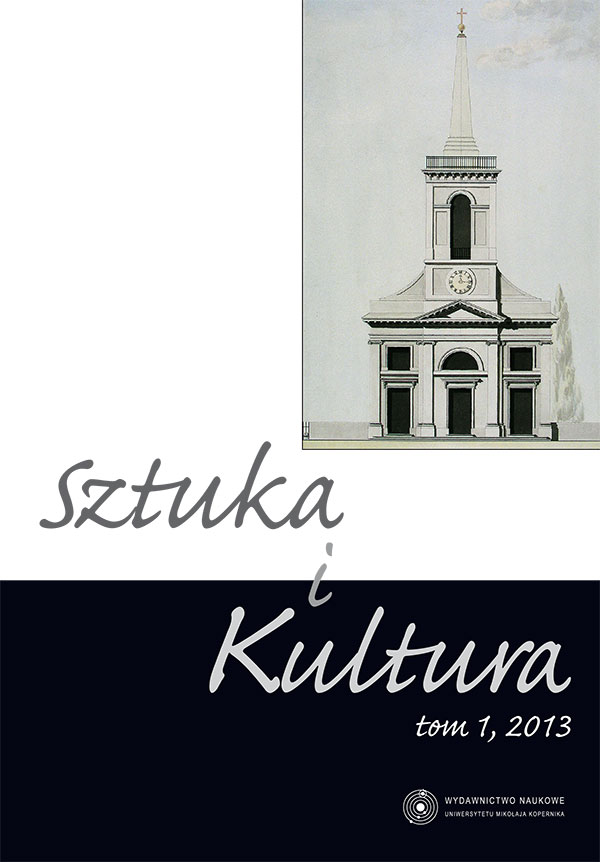
The architect Stanisław Zawadzki is known first and foremost, as an author of residential and military buildings, but much less as a designer of sacral architecture. The preserved designs, however, do not allow us to doubt, that it was him, who can be regarded as an author of a parish church in Nowy Dwór Mazowiecki, near Warsaw. As an architect, he may have been cooperating permanently in various fields with the town owner – the Grand Treasurer of Lithuania Stanisław Poniatowski, a nephew of king Stanisław August. He was also the author of urban expanding project, concerning all the agglomeration and more important public buildings situated there (among the others, a town hall). Identifying present object with the preserved designs makes us conclude, that Nowy Dwór temple has kept until today its 18th c form in almost untouched condition (despite adding to its body a new church in 20th c). The spatial nave arranged with style – completed with the presbytery and flanked with the vestry and the treasury, also built up with the patrons’ lodges – gained a hall character. The façade, referring to a three-pass triumphal arch motif, is topped with an immense bell tower, capped with an obelisk-shaped spire. Although, the monumental architecture has preserved until present times, the equipment (three altars, the pulpit, the baptismal font and two confessionals), specially designed for that interior, has barely remained. The temple erecting period was changed of several years (basing on newly revealed written sources) – from the year 1792 till the fall of the 70s of 18th c – which makes us attribute this construction a groundbreaking character in comparison to numerous classicistic small brick parish churches, erected frequently all around Masovia during the Enlightenment period. The historical structure in Nowy Dwór seems to be definitely less innovative than the other sacral object designed by Stanisław Zawadzki; a parish church in Krzyżanowice, built between 1786–1789, being an uncompromising attempt of returning to ‘early Christian rigour in style’, inspired by Hugo Kołłątaj, who tried to put in practice the ideas of the Catholic Enlightenment. However, the structure inscribed into sacral building tradition, which was formed in post- Council of Trent period – now in accordance with the classicism rules, deprived of splendor and richness, affecting only by the means of its simplicity and the grandeur of forms – fulfilled successfully the requirements of liturgy and did not interfere into the habits of the clergy and the laity. Therefore, the temple in Krzyżanowice has remained an isolated example, deprived of the followers, while the church in Nowy Dwór Mazowiecki became a pattern of practical solutions, implemented later commonly in sacral architecture.
Downloads
Published
How to Cite
Issue
Section
Stats
Number of views and downloads: 916
Number of citations: 0


