Transcriptome Analysis of Porcine Liver Reveals Hepatoprotective Mechanisms of Dietary Curcuma Longa Extract Supplementation against Aflatoxin B1: A Single-Cell RNA Sequencing Perspective
DOI:
https://doi.org/10.12775/TRVS.2026.001Keywords
Aflatoxin B1 (AFB1), Hepatotoxicity, Single-cell RNA sequencing (scRNA-seq), Curcuma longaAbstract
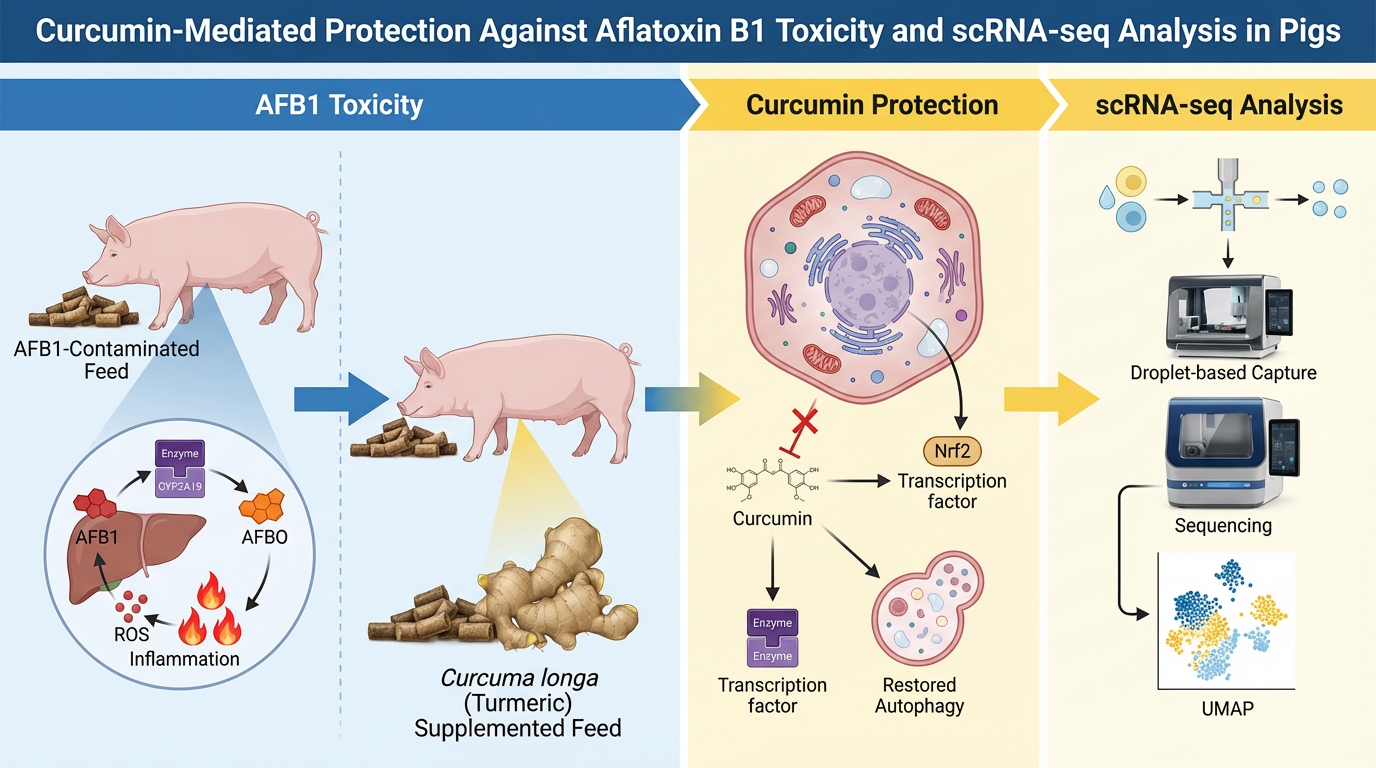
Aflatoxin B1 (AFB1), a potent mycotoxin produced by Aspergillus species, poses significant threats to livestock health and food safety, particularly in swine production. AFB1-induced hepatotoxicity involves complex molecular mechanisms including cytochrome P450-mediated bioactivation, oxidative stress, inflammatory responses, and disrupted cellular homeostasis. Dietary supplementation with Curcuma longa extract (curcumin) has emerged as a promising hepatoprotective intervention, demonstrating efficacy through multiple molecular pathways including inhibition of phase-I bioactivation, activation of Nrf2-driven antioxidant responses, anti-inflammatory effects, and restoration of autophagy. While bulk transcriptomic studies in porcine models have revealed broad gene expression changes, single-cell RNA sequencing (scRNA-seq) offers unprecedented resolution to dissect cell-type-specific responses in the heterogeneous liver microenvironment. This review synthesizes current evidence on AFB1 hepatotoxicity mechanisms, curcumin's hepatoprotective pathways, and the transformative potential of scRNA-seq technology to resolve cellular heterogeneity in porcine liver responses to mycotoxin exposure and dietary intervention. We highlight the critical role of porcine-specific cytochrome P450 2A19 in AFB1 bioactivation, intercellular communication via extracellular vesicles in fibrogenesis, and the methodological advances enabling single-cell transcriptomic in primary porcine hepatocytes. This synthesis provides a roadmap for future scRNA-seq studies to definitively map cell-type-specific protective mechanisms of curcumin against AFB1 hepatotoxicity in swine.
Acknowledgement
This research is financed and supported by the scientific project NCN-OPUSLAP (UMO-2021/43/I/NZ9/02612) entitled: Multilevel molecular analysis of the hepatoprotective effect of medicinal herbs extracts in prevention of liver dysfunction caused by aflatoxin B1 in pig as an animal model (in-vivo), and hepatocyte cell culture analysis in human and pig (in-vitro).
References
[1]. Kępka-Borkowska K, Chałaśkiewicz K, Ogłuszka M, Borkowski M, Lepczyński A, Pareek CS, et al. Current Approaches to Aflatoxin B1 Control in Food and Feed Safety: Detection, Inhibition, and Mitigation. Int J Mol Sci. 2025;26:6534. https://doi.org/10.3390/ijms26136534.
[2]. Sharma P, Asediya V, Kalra G, Sultana S, Purohit N, Kibitlewska K, et al. Hepatoprotective Effect of Silymarin Herb in Prevention of Liver Dysfunction Using Pig as Animal Model. Nutrients. 2025;17:3278. https://doi.org/10.3390/nu17203278.
[3]. Wang Z, Huang Q, Zhang F, Wu J, Wang L, Sun Y, et al. Key Role of Porcine Cytochrome P450 2A19 in the Bioactivation of Aflatoxin B 1 in the Liver. J Agric Food Chem. 2024;72:2334–46. https://doi.org/10.1021/acs.jafc.3c08663.
[4]. Kalra Garima. Decoding Silymarin: A Multi-Omics Blueprint for Precision Hepatoprotection. Translational Research in Veterinary Science. 2025;8.
[5]. Kibitlewska K, Asediya V, Karpiesiuk K, Czarnik U, Lecewicz M, Wysocki P, et al. Hepatoprotective Potential of Curcumin in the Prevention of Liver Dysfunction in a Porcine Model. Nutrients. 2026;18:408. https://doi.org/10.3390/nu18030408.
[6]. Li S, Zhang Y, Ishfaq M, Liu R, Wei G, Zhang X. Curcumin alleviates Aflatoxin B1-triggered chicken liver necroptosis by targeting the LOC769044/miR-1679/STAT1 axis. Poult Sci. 2024;103:103883. https://doi.org/10.1016/j.psj.2024.103883.
[7.] Sharma P. From Tissue to Transcriptome: A Robust Pipeline for Single-Cell RNA-seq of Primary Porcine Hepatocytes. Translational Research in Veterinary Science. 2025;8. https://doi.org/10.12775/TRVS.2025.003.
[8]. Chałaśkiewicz K, Kępka-Borkowska K, Starzyński RR, Ogłuszka M, Borkowski M, Poławska E, et al. Impact of Aflatoxins on the Digestive, Immune, and Nervous Systems: The Role of Microbiota and Probiotics in Toxicity Protection. Int J Mol Sci. 2025;26:8258. https://doi.org/10.3390/ijms26178258.
[9]. Jin S, Yang H, Wang Y, Pang Q, Jiao Y, Shan A, et al. Dietary Curcumin Alleviated Aflatoxin B1-Induced Acute Liver Damage in Ducks by Regulating NLRP3–Caspase-1 Signaling Pathways. Foods. 2021;10:3086. https://doi.org/10.3390/foods10123086.
[10]. Singh KB, Maurya BK, Trigun SK. Activation of oxidative stress and inflammatory factors could account for histopathological progression of aflatoxin-B1 induced hepatocarcinogenesis in rat. Mol Cell Biochem. 2015;401:185–96. https://doi.org/10.1007/s11010-014-2306-x.
[11]. Sethi N, Khokhar M, Mathur M, Batra Y, Mohandas A, Tomo S, et al. Therapeutic Potential of Nutraceuticals against Drug-Induced Liver Injury. Semin Liver Dis. 2024;44:430–56. https://doi.org/10.1055/s-0044-1791559.
[12]. Dai C, Sharma G, Liu G, Shen J, Shao B, Hao Z. Therapeutic detoxification of quercetin for aflatoxin B1-related toxicity: Roles of oxidative stress, inflammation, and metabolic enzymes. Environmental Pollution. 2024;345:123474. https://doi.org/10.1016/j.envpol.2024.123474.
[13]. Kang K, Zhang Y, Xie W, Ma W, Chen J, Chen Z. Astaxanthin attenuates AFB1-induced hepatotoxicity by activating Nrf2 and inhibiting the NF-κB signaling pathway. Ecotoxicol Environ Saf. 2025;303. https://doi.org/10.1016/j.ecoenv.2025.119025.
[14]. Yang L, Gao YL, Jiang S, Qian B, Che L, Wu JS, et al. Aflatoxin B1-exposed hepatocyte-derived extracellular vesicles: Initiating hepatic stellate cell-mediated liver fibrosis through a p53-Parkin-dependent mitophagy pathway. Ecotoxicol Environ Saf. 2024;277. https://doi.org/10.1016/j.ecoenv.2024.116363.
[15]. Puttegowda VD. Herbal Protectants For Liver Function During Health Challenges. In: Advancements in Hepatoprotective Herbal Medicines Current Trends, Significance and Future Perspectives. Genome Publications; 2025. p. 241–58. https://doi.org/10.61096/978-81-981372-8-9_13.
[16]. Meurisse N, Wylin T, Heedfeld V, Fieuws S, Ceulemans L, Jochmans I, et al. Effects of Cyclodextrin Curcumin Formulation on Ischemia-Reperfusion Injury in Porcine DCD Liver Transplantation. Transplantation. 2024;108:2366–73. https://doi.org/10.1097/TP.0000000000005117.
[17]. Frangiamone M, Lázaro Á, Cimbalo A, Font G, Manyes L. In vitro and in vivo assessment of AFB1 and OTA toxic effects and the beneficial role of bioactive compounds. A systematic review. Food Chemistry. 2024;447. https://doi.org/10.1016/j.foodchem.2024.138909.
[18]. Zhang J, Sun X, Chai X, Jiao Y, Sun J, Wang S, et al. Curcumin Mitigates Oxidative Damage in Broiler Liver and Ileum Caused by Aflatoxin B1-Contaminated Feed through Nrf2 Signaling Pathway. Animals. 2024;14. https://doi.org/10.3390/ani14030409.
[19]. Zhang L, Bao Y, Gong X, Ma S, Wang X, Shi W. Danshen Polysaccharides Alleviate Aflatoxin B1-Induced Liver Damage and Immune Disorders by Inhibiting the ROS-Mediated Mitochondrial Apoptosis Pathway. Antioxidants. 2025;14. https://doi.org/10.3390/antiox14080991.
[20]. Ezhilarasan D, Langeswaran K. Hepatocellular Interactions of Potential Nutraceuticals in the Management of Inflammatory NAFLD. Cell Biochemistry and Function. 2024;42. https://doi.org/10.1002/cbf.4112.
[21]. He Y, Chen X, Li Y, Liang Y, Hong T, Yang J, et al. Curcumin supplementation alleviates hepatic fat content associated with modulation of gut microbiota-dependent bile acid metabolism in patients with nonalcoholic simple fatty liver disease: a randomized controlled trial. American Journal of Clinical Nutrition. 2024;120:66–79. https://doi.org/10.1016/j.ajcnut.2024.05.017.
[22]. Shah I, Gallegos D, Robinette B, Chambers BA, Eastburn DJ, Bell DA, et al. Decoding Cellular Stress States for Toxicology Using Single-Cell Transcriptomics. 2025. https://doi.org/10.1101/2025.06.10.657506.
[23]. Dini Permata Sari, Nhila Putri Evani, Rangki Astiani. Peran Tablet Curcuma Dalam Menurunkan Risiko Hepatotoksisitas Pada Pasien Tb Paru Yang Menjalani Terapi Oat Di Rs Pasar Rebo Kota Jakarta Timur. Journal Pharma Saintika. 2025;9:24–35. https://doi.org/10.51225/jps.v9i1.88.
[24]. Li Z, Liu M, Li J, Yan G, Xu X. Diosmetin alleviates AFB1-induced endoplasmic reticulum stress, autophagy, and apoptosis via PI3K/AKT pathway in mice. Ecotoxicol Environ Saf. 2025;292:117997. https://doi.org/10.1016/j.ecoenv.2025.117997.
[25]. Mao J, Wei Y, Ni Z, Zhang J, Zhu J, Wang H. Gut microbiota-mediated bile acid transformations regulate the transport of aflatoxin B1 from the intestine to the liver in piglets. J Anim Sci Biotechnol. 2025;16:38. https://doi.org/10.1186/s40104-025-01169-x.
[26]. Yang D, Zhang S, Cao H, Wu H, Liang Y, Teng CB, et al. Detoxification of Aflatoxin B1 by Phytochemicals in Agriculture and Food Science. Journal of Agricultural and Food Chemistry. 2024;72:14481–97. https://doi.org/10.1021/acs.jafc.4c01796.
[27]. Yang L, Gao Y-L, Jiang S, Qian B, Che L, Wu J-S, et al. Aflatoxin B1-exposed hepatocyte-derived extracellular vesicles: Initiating hepatic stellate cell-mediated liver fibrosis through a p53-Parkin-dependent mitophagy pathway. Ecotoxicol Environ Saf. 2024;277:116363. https://doi.org/10.1016/j.ecoenv.2024.116363.
[28]. Nalpadan AA, Reyer H, Oster M, Trakooljul N, Ponsuksili S, Kozera W, et al. Transcriptional insights into aflatoxin B1 induced hepatotoxicity and comparative effects of medicinal herbs in pigs. BMC Vet Res. 2026;22:53. https://doi.org/10.1186/s12917-025-05270-1.
[29]. Li S, Liu R, Wei G, Guo G, Yu H, Zhang Y, et al. Curcumin protects against Aflatoxin B1-induced liver injury in broilers via the modulation of long non-coding RNA expression. Ecotoxicol Environ Saf. 2021;208:111725. https://doi.org/10.1016/j.ecoenv.2020.111725.
[30]. Muhmood A, Liu J, Liu D, Liu S, Azzam MM, Junaid MB, et al. Mitigation of Deoxynivalenol (DON)- and Aflatoxin B1 (AFB1)-Induced Immune Dysfunction and Apoptosis in Mouse Spleen by Curcumin. Toxins (Basel). 2024;16. https://doi.org/10.3390/toxins16080356.
Downloads
Published
How to Cite
Issue
Section
License
Copyright (c) 2026 Purohit N

This work is licensed under a Creative Commons Attribution-NoDerivatives 4.0 International License.
Title, logo and layout of TR in VS are reserved trademarks of TR in VR.
Stats
Number of views and downloads: 87
Number of citations: 0


