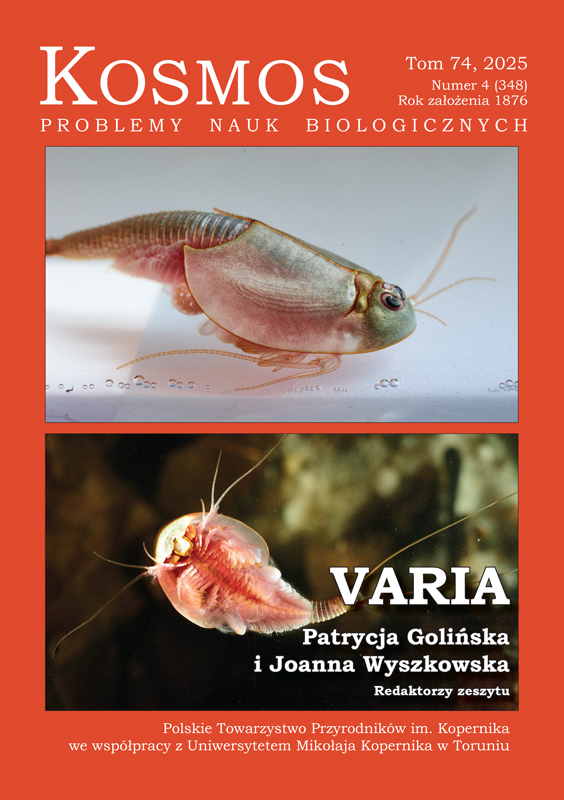
A A review of the Ecology and Biology of Tadpole Shrimp (Crustacea: Branchiopoda: Notostraca)
DOI:
https://doi.org/10.12775/KOSMOS.2025.033Keywords
tadpole shrimp, Branchiopoda, ephemeral ponds, ecologyAbstract
Notostracans usually inhabit periodic reservoirs characterised by unstable physical and chemical conditions, to which they have developed several morphological and physiological adaptations. Notostracans are known for their ability to lay resistant to extreme environmental conditions eggs (dormant eggs), i.e. drying out, freezing, or high temperatures. Due to its morphological conservatism, it has been labeled a "living fossil," but it is now recognized as a stabilomorph. Due to its unusual appearance, tadpole shrimp are highly sought after by aquarium enthusiasts and increasingly popular among researchers for laboratory studies in ecotoxicology and behavior. Human activities directly impact the occurrence of these crustaceans, as habitat loss due to drainage or pollution contributes to the decline of tadpole shrimp habitats. Due to habitat loss, tadpole shrimp are endangered, hence the importance of protecting their habitats. This is especially crucial since such small, temporary water bodies play a significant role in local biodiversity.
References
Boix D., Sala J., Gascón S., Brucet S., 2006. Predation in a temporary pond with special attention to the trophic role of Triops cancriformis (Crustacea: Branchiopoda: Notostraca). Hydrobiologia 571. https://doi.org/10.1007/s10750-006-0259-0
Bujak G., 2016. Tempo rozwoju cyst, stadiów larwalnych i dorosłych przekopnicy właściwej [Triops cancriformis (Bosc, 1801)] w warunkach hodowli laboratoryjnej. Acta Juvenum 1.
Buscaino G., Ceraulo M., Canale D. E., Papale E., Marrone F., 2021. First evidence of underwater sounds emitted by the living fossils Lepidurus lubbocki and Triops cancriformis (Branchiopoda: Notostraca). Aquatic Biology 30. https://doi.org/10.3354/AB00744
Copilaş-Ciocianu D., Rewicz T., Sands A. F., Palatov D., Marin I., Arbačiauskas K., Audzijonyte A., 2022. A DNA barcode reference library for endemic Ponto-Caspian amphipods. Scientific Reports 12, 11332. https://doi.org/10.1038/s41598-022-15442-w
Crossland N. O., 1965. Pest status and control of the tadpole shrimp, Triops (Apus) granarius, and of the snail, Lanistes ovum in Swaziland rice fields. Journal of Applied Ecology 2, 1. https://doi.org/10.2307/2401697
Czyż M. J., Woliński P., Gołdyn B., 2016. Cyst morphology of large branchiopod crustaceans (Anostraca, Notostraca, Laevicaudata, Spinicaudata) in western Poland. Biological Letters 53, 2. https://doi.org/10.1515/biolet-2017-0006
Dumont H. J., Negrea S. V., 2002. Introduction to the class Branchiopoda. Backhuys Publishers.
Dzik J., 2015. Zoologia. Różnorodność i pokrewieństwa zwierząt. Wydawnictwa Uniwersytetu Warszawskiego.
Fiszer Z., 1885. Materyjały do fauny krajowych skorupiaków liścionogich (Phyllopoda), w: Pamiętnik Fizyograficzny. Chałubiński T., Aleksandrowicz J., Deike K., Dudrewicz L., Dziewulski E., Jurkiewicz K., Kramsztyk S., Ślósarski A., Trejdosiewicz J., Wałecki A., Wrześniowski A., Znatowicz B. (Red.). Warszawa, s. 195–201.
Fryer G., 1988. Studies on the Functional Morphology and Biology of the Notostraca (Crustacea: Branchiopoda). Royal Society 321, 1203. https://doi.org/10.1098/rstb.1988.0091
Fry-O-Brien L. L., Mulla M. S., 1996. Optimal conditions for rearing the tadpole shrimp. Triops longicaudatus (Notostraca: Triopsidae), a biological control agent against mosquitoes. Journal of the American Mosquito Control Association 12, 3.
Gołdyn B., Bernard R., Czyż M. J., Jankowiak A., 2012. Diversity and conservation status of large branchiopods (Crustacea) in ponds of western Poland. Limnologica 42, 4. https://doi.org/10.1016/j.limno.2012.08.006
Gołdyn B., Bernard R. 2008. Preliminary data onthe distribution and phenology of Eubranchipusgrubii (Dybowski 1860) (Crustacea: Anostraca)in the Wielkopolska region. Annales UMCS,Sectio C, 63 (2): 23–29. https://doi.org/10.2478/v10067-008-0015-0
Gołdyn B., Konwerski Sz., Błoszyk J. 2007. Largebranchiopods (Anostraca, Notostraca, Spinicau-data, Laevicaudata) of small, astatic waterbodiesin the environs of Poznań (Wielkopolska Region,Western Poland). Oceanological and Hydrobiological Studies 36, Suppl. 4: 21–28.
Grabda E., 1985. Gromada: Crustacea – skorupiaki w: Zoologia. Bezkręgowce. Grabda E. (Red.). Państwowe Wydawnictwo Naukowe, Warszawa, s. 155–191.
Guimarães, Laura, António Paulo Carvalho, Pedro Ribeiro, Cláudia Teixeira, Nuno Silva, André Pereira, João Amorim, Luís Oliva-Teles. 2024. Sensitivity of Triops longicaudatus Locomotor Behaviour to Detect Short Low-Level Exposure to Pollutants. Water 16, no. 1: 126. https://doi.org/10.3390/w16010126
Hempel J., 1963. Obserwacje biologiczne nad przekopnicą Triops cancriformis (Bosc) w warunkach naturalnych i w hodowli. Annales Zoologici 20, 18.
Horn R. L., Cowley D. E., 2016. Self-fertilization and the role of males in populations of tadpole shrimp (branchiopoda: Notostraca: Triops). Journal of Heredity 107, 518–526. https://doi.org/10.1093/jhered/esw040
Jura C., 2005. Gromada skrzelonogi – Branchiopoda w: Bezkręgowce. Podstawy morfologii funkcjonalnej, systematyki i filogenezy. Jura C. (Red.). Wydawnictwo Naukowe PWN, Warszawa, s. 435–442.
Jurasz W., 2013. Gromada: Skrzelonogi (Branchiopoda) w: Zoologia. Stawonogi. Tom 2, część 1. Szczękoczułkopodobne, Skorupiaki, Błaszak Cz. (Red.). Wydawnictwo Naukowe PWN, Warszawa, s. 264–270.
Kin A., Błażejowski B., 2014. The Horseshoe Crab of the Genus Limulus: Living Fossil or Stabilomorph? PLoS ONE 9, 10. https://doi.org/10.1371/journal.pone.0108036
Lagebro L., Gueriau P., Hegna T. A., Rabet N., Butler A. D., Budd G. E., 2015. The oldest notostracan (Upper Devonian Strud locality, Belgium). Palaeontology 58, 3. https://doi.org/10.1111/pala.12155
Lakka H.-K., 2013. The ecology of a freshwater crustacean: Lepidurus arcticus (Brachiopoda; Notostraca) in a High Arctic region. University Of Helsinki Department Of Environmental Sciences (praca magisterska), 1–151.
Lerosey-Aubril R., Meyer R., 2013. The sensory dorsal organs of crustaceans. Biological Reviews 88, 2. https://doi.org/10.1111/brv.12011
Longhurst A. R., 1955. A review of the Notostraca. The Zoological Society of London 125, 1. https://doi.org/10.1111/j.1096-3642.1955.tb00621.x
Mabidi A., Bird M. S., Perissinotto R., Christopher Rogers D., 2016. Ecology and distribution of large branchiopods (Crustacea, Branchiopoda, Anostraca, Notostraca, Laevicaudata, Spinicaudata) of the Eastern Cape Karoo, South Africa. ZooKeys 618, 9212. https://doi.org/10.3897/zookeys.618.9212
Mathers T. C., Hammond R. L., Jenner R. A., Zierold T., Hänfling B., Gómez A., 2013. High lability of sexual system over 250 million years of evolution in morphologically conservative tadpole shrimps. BMC Evolutionary Biology 13, 30. https://doi.org/10.1186/1471-2148-13-30
Naganagwa H., 2020. Invasive Alien Species Triops (Branchiopoda: Notostraca) in Japan and its Ecological and Economic Impact. Reviews in Agricultural Science 8. https://doi.org/10.7831/ras.8.0_138
Negrea S., Botnariuc N., Dumont H. J., 1999. Phylogeny, evolution and classification of the Branchiopoda (Crustacea). Hydrobiologia 412. https://doi.org/10.1023/a:1003894207100
Olesen J., 2018. Crustacean Life Cycles – Developmental Strategies and Environmental Adaptations w: The Natural History of the Crustacea: Life Histories, Wellborn G. A. Thiel M. (red.). Oxford University Press, Oksford, s. 1–34. https://doi.org/10.1093/oso/9780190620271.003.0001
Olesen J., Moller O. S., 2014. Notostraca w: Atlas of Crustacean Larvae, Martin J. W., Olesen J., Hoeg J. T. (red.). Johns Hopkins University Press, Baltimore, s. 40–47.
Pereira A. C., Saraiva A., Oliva-Teles L., Guimarães L., Carvalho A. P., 2024. Ecotoxicological Effects of Potassium Dichromate on the Tadpole Shrimp Triops longicaudatus. Animals 14, 3. https://doi.org/10.3390/ani14030358
Rogacki M., Brysiewicz A., 2021. Tadpole Shrimps – A General Review of the Little Known Crustaceans of Ephemeral Waterbodies. Research in Ecology 3, 2. https://doi.org/10.30564/re.v3i2.2910
Schernhammer T., Wessely J., Eder E., Straka U., Essl F., 2020. Modelling the distribution of large branchiopods (Crustacea: Notostraca, Anostraca & Spinicaudata) for predicting occurrences in poorly sampled regions. Global Ecology and Conservation 23. https://doi.org/10.1016/j.gecco.2020.e01083
Sellers G. S., Griffin L. R., Hänfling B., Gómez A., 2017. A new molecular diagnostic tool for surveying and monitoring triops cancriformis populations. PeerJ 5, 3228. https://doi.org/10.7717/peerj.3228
Stańczykowska A., 1986. Zwierzęta bezkręgowe naszych wód. WSIP Wydawnictwa Szkolne i Pedagogiczne, Warszawa.
Sun X. Y., Xia X., Yang Q., 2016. Dating the origin of the major lineages of Branchiopoda. Palaeoworld 25, 2. https://doi.org/10.1016/j.palwor.2015.02.003
Tindall K. V., Fothergill K., Minson W., Ottis B., 2009. A New Pest of Rice in Missouri: Range Expansion of Triops longicaudatus (Crustacea: Notostraca: Triopsidae) into the Northern Mississippi river alluvial plains. Florida Entomologist 92, 3. https://doi.org/10.1653/024.092.0314
Tindall K. V., Fothergill K., 2012. A Review of a New Pest of Rice, Tadpole Shrimp (Notostraca: Triopsidae), in the Midsouthern United States and a winter Scouting Method of rice fields for Preplanting Detection. Journal of Integrated Pest Management 3, 3. https://doi.org/10.1603/IPM12001
Vanschoenwinkel B., Pinceel T., Vanhove M. P. M., Denis C., Jocque M., Timms B. V., Brendonck L., 2012. Toward a global phylogeny of the „Living Fossil” Crustacean order of the Notostraca. PLoS ONE 7, 4. https://doi.org/10.1371/journal.pone.0034998
Wagner P., Haug J. T., Sell J., Haug C., 2017. Ontogenetic sequence comparison of extant and fossil tadpole shrimps: no support for the “living fossil” concept. PalZ 91. https://doi.org/10.1007/s12542-017-0370-8
Wagner P., Haug, J., H. Carolin., 2019. A new calmanostracan crustacean species from the Cretaceous Yixian Formation and a simple approach for differentiating fossil tadpole shrimps and their relatives. Zoological Letters 5, 20. https://doi.org/10.1186/s40851-019-0136-0
Walossek D., 1993. The Upper Cambrian Rehbachiella and the phylogeny of Branchiopoda and Crustacea. Lethaia 26, 4. https://doi.org/10.1111/j.1502-3931.1993.tb01537.x
Waterkeyn A., Vanschoenwinkel B., Elsen S., Anton-Pardo M., Grillas P., Brendonck L., 2010. Unintentional dispersal of aquatic invertebrates via footwear and motor vehicles in a Mediterranean wetland area. Aquatic Conservation: Marine and Freshwater Ecosystems 20, 5. https://doi.org/10.1002/aqc.1122
Werneburg Ralf, Schneider Joerg W., 2022. New branchiopod crustaceans from the late Carboniferous and early Permian of the Thuringian Forest Basin, Germany, with a review of Permian notostracans from the Lodève basin, France. Semana 37.
Zwolski W., 1885. Materyjały do fauny krajowych skorupiaków liścionogich (Phyllopoda). Pamiętnik Fizyograficzny.
AKTY PRAWNE
Rozporządzenie Ministra Środowiska z dnia 16 grudnia 2016 r. w sprawie ochrony gatunkowej zwierząt (Dz.U. 2016 poz. 2183).
ŹRÓDŁA INTERNETOWE
GBIF, 2023. GBIF.org https://doi.org/10.15468/dl.8cpqcp (dostęp 18.12.2023).
GBIG, 2023. GBIF.org https://doi.org/10.15468/dl.as44t3 (dostęp 18.12.2023).
World Register of Marine Species, 2023. https://marinespecies.org/aphia.php?p=taxdetails&id=1803 (dostęp 25.11.2023)
BoldSystems, 2024. https://www.boldsystems.org/index.php/Taxbrowser_Taxonpage?searchMenu=taxon my&query=notostraca&taxon=notostraca (dostęp 02.06.2024).
Encyklopedia PWN, 2024. https://encyklopedia.pwn.pl/haslo/zywe-skamienialosci;4003368
(dostęp 02.06.2024).
IUCN Red List of Threatened Species, 2024. https://www.iucnredlist.org/search?query=Tadpole%20Shrimps&searchType=species
(dostęp 22.06.2024).
ISAP – Internetowy System Aktów Prawnych, 2024. https://isap.sejm.gov.pl/isap.nsf/DocDetails.xsp?id=WDU20160002183 (dostęp 23.06.2024).
Downloads
Published
Issue
Section
License
Copyright (c) 2026 KOSMOS

This work is licensed under a Creative Commons Attribution 4.0 International License.
Stats
Number of views and downloads: 153
Number of citations: 0