Skip to main content Skip to main navigation menu Skip to site footer
  • Register
  • Login
  • Language
    • English
    • Deutsch
    • Język Polski
    • Español (España)
    • Italiano
    • Français (Canada)
    • Čeština

Akademicka Platforma Czasopism

  • Menu
  • Home
  • Current
  • Archives
  • Announcements
  • About
    • About the Journal
    • Submissions
    • Editorial Team
    • Privacy Statement
    • Contact
  • Register
  • Login
  • Language:
  • English
  • Deutsch
  • Język Polski
  • Español (España)
  • Italiano
  • Français (Canada)
  • Čeština
Institutions as the forces stabilizing state. Contemporary look at Arnold Gehlen's theory of institutions
  • Home
  • /
  • Institutions as the forces stabilizing state. Contemporary look at Arnold Gehlen's theory of institutions
  1. Home /
  2. Archives /
  3. No. 18 (2015) /
  4. Articles

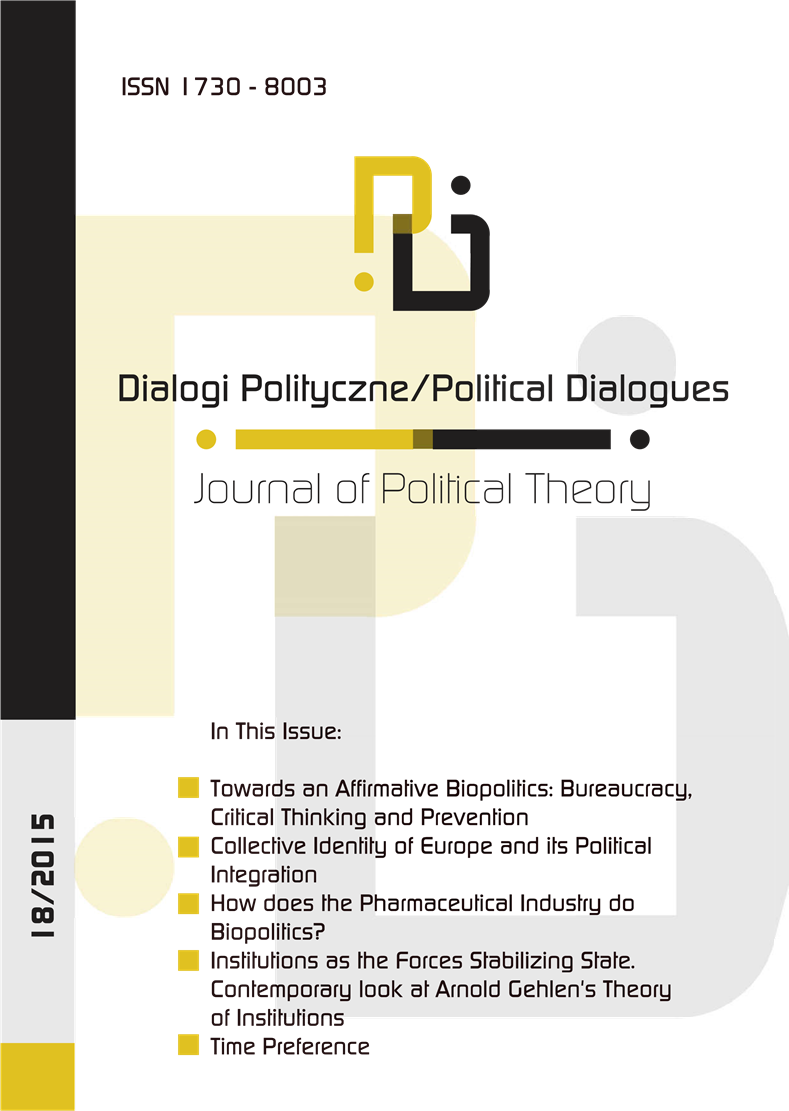
Institutions as the forces stabilizing state. Contemporary look at Arnold Gehlen's theory of institutions

Authors

  • Sonia Horonziak Jagiellonian University in Krakow. Faculty of International and Political Studies. Institute of Political Science and International Relations.

DOI:

https://doi.org/10.12775/DP.2015.010

Keywords:

political anthropology, philosophical anthropology, theory of institutions, moral hypertrophy, state order

Abstract

Gehlen's theory of institutions shows how thinking about the further prospect of human activities can create the base for constructing institutions. Strong and stable institutions provide social support to the activities of individuals. A man without institution is not able to arouse the motivation for action-oriented ideal. What's more man without the institutions does not know who he is. People needs mediation to understand themselves and that can be provided by the institutions. The necessity of institutions is shown by presenting the chaos that can destroyed lives when they are weakened or liquidated. Gehlen's thesis is clear - without a permanent institutions and without preserving tradition - a true and stable state order is not possible. When system developed for generations stops working, individuals begin to behave in a selfish way, follow only by personal pleasure and potential profit. Nowadays, when state became the subject of an attack by society, the question arises: is it able to become one more time a guard of social order and the embodiment of political virtues? Gehlen's theory of institutions can provide a starting point for discussion of changes that need to be taken to restore the real possibility of political order in the country.

Author Biography

Sonia Horonziak, Jagiellonian University in Krakow. Faculty of International and Political Studies. Institute of Political Science and International Relations.

PhD student at the Jagiellonian University in Krakow in the political science. From 2013 student of the interdisciplinary studies for PhD students: Society-Environment-Technology (also receiver of a scholarship from the project). Master's in politology in 2013, specialization: political journalism. Master's thesis entitled: "Helmuth Plessner. From philosophical anthropology to political anthropology" was awarded with a prize for the best master's thesis at the Faculty of International and Political Studies of the Jagiellonian University.

References

Colapietro V.M. (1990). The Reconstruction of Institutions, “The Journal of Speculative Philosophy”, 4 (3).

Czerniak S. (1998). Pomiędzy Szkołą Frankfurcką a postmodernizmem. Antropologia filozoficzna Gernota Böhmego na tle klasycznych stanowisk antropologii filozoficznej XX wieku, Böhme G., „Antropologia filozoficzna. Ujęcie pragmatyczne”, IFiS PAN, Warszawa.

Delitz H. (2011). Arnold Gehlen, UVK, Konstanz.

Gehlen A. (2001). W kręgu antropologii i psychologii społecznej, Czytelnik, Warszawa.

Gehlen A. (2004). Moral und Hypermoral, Aula, Frankfurt am Main.

Rehberg K.-S. (1995). Antropologia działania i teoria porządku Arnolda Gehlena, „Konserwatyzm. Projekt teoretyczny”, Polskie Towarzystwo Filozoficzne, Warszawa.

Gehlen A. (1989). Instytucje, „Zdanie”, (11-12).

Gehlen A. (1989). Państwo, „Zdanie”, (11-12).

Gehlen A. (1989). Hipertrofia Moralności, „Zdanie”, (11-12).

Honneth A., Joas H. (1988). Social Action and Human Nature, Cambridge University Press, Cambridge.

Huizinga J. (1972). Puerilism, “Salmagundi”, (20).

Kimla P. (2005). Arnold Gehlen w obronie klasycznych zadań władzy i instytucji państwa, „Państwo i społeczeństwo”, (1).

MacCormick N. (1998), Norms, Institutions, and Institutional Facts, “Law and Philosophy”,

(3).

Paczkowska-Łagowska E. (2012). O historyczności człowieka , słowo/obraz terytoria, Gdańsk.

Thies C. (2000). Gehlen zur Einfürung, Junius, Hamburg.
Downloads

  • PDF

Published

2016-03-29

How to Cite

1.
HORONZIAK, Sonia. Institutions as the forces stabilizing state. Contemporary look at Arnold Gehlen’s theory of institutions. Political Dialogues. Online. 29 March 2016. No. 18, pp. 113-122. [Accessed 3 January 2026]. DOI 10.12775/DP.2015.010.
  • ISO 690
  • ACM
  • ACS
  • APA
  • ABNT
  • Chicago
  • Harvard
  • IEEE
  • MLA
  • Turabian
  • Vancouver
Download Citation
  • Endnote/Zotero/Mendeley (RIS)
  • BibTeX

Issue

No. 18 (2015)

Section

Articles

Stats

Number of views and downloads: 796
Number of citations: 0

Search

Search

Browse

  • Browse Author Index
  • Issue archive

User

User

Current Issue

  • Atom logo
  • RSS2 logo
  • RSS1 logo

Information

  • For Readers
  • For Authors
  • For Librarians

Newsletter

Subscribe Unsubscribe

Language

  • English
  • Deutsch
  • Język Polski
  • Español (España)
  • Italiano
  • Français (Canada)
  • Čeština

Tags

Search using one of provided tags:

political anthropology, philosophical anthropology, theory of institutions, moral hypertrophy, state order
Up

Akademicka Platforma Czasopism

Najlepsze czasopisma naukowe i akademickie w jednym miejscu

apcz.umk.pl

Partners

  • Akademia Ignatianum w Krakowie
  • Akademickie Towarzystwo Andragogiczne
  • Fundacja Copernicus na rzecz Rozwoju Badań Naukowych
  • Instytut Historii im. Tadeusza Manteuffla Polskiej Akademii Nauk
  • Instytut Kultur Śródziemnomorskich i Orientalnych PAN
  • Instytut Tomistyczny
  • Karmelitański Instytut Duchowości w Krakowie
  • Ministerstwo Kultury i Dziedzictwa Narodowego
  • Państwowa Akademia Nauk Stosowanych w Krośnie
  • Państwowa Akademia Nauk Stosowanych we Włocławku
  • Państwowa Wyższa Szkoła Zawodowa im. Stanisława Pigonia w Krośnie
  • Polska Fundacja Przemysłu Kosmicznego
  • Polskie Towarzystwo Ekonomiczne
  • Polskie Towarzystwo Ludoznawcze
  • Towarzystwo Miłośników Torunia
  • Towarzystwo Naukowe w Toruniu
  • Uniwersytet im. Adama Mickiewicza w Poznaniu
  • Uniwersytet Komisji Edukacji Narodowej w Krakowie
  • Uniwersytet Mikołaja Kopernika
  • Uniwersytet w Białymstoku
  • Uniwersytet Warszawski
  • Wojewódzka Biblioteka Publiczna - Książnica Kopernikańska
  • Wyższe Seminarium Duchowne w Pelplinie / Wydawnictwo Diecezjalne „Bernardinum" w Pelplinie

© 2021 Akademicka Platforma Czasopism Sklep wydawnictwa