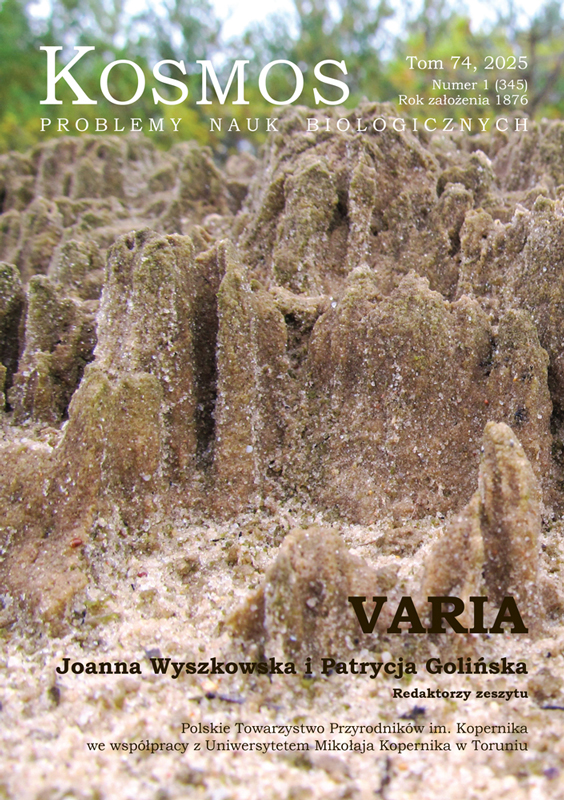
Biologiczne skorupy glebowe – niewidoczni inżynierowie ekosystemów
DOI:
https://doi.org/10.12775/KOSMOS.2025.010Słowa kluczowe
biologiczne skorupy glebowe, obszary suche, gleba, sukcesja ekologiczna, wskaźniki funkcjonalneAbstrakt
Biologiczne skorupy glebowe (bioskorupy) to asocjacje sinic (cyjanobakterii), glonów, porostów, mszaków i mikroorganizmów heterotroficznych ściśle związanych z cząstkami gleby i tworzących miniaturowy ekosystem na jej powierzchni. Rozwijają się w szerokim spektrum warunków klimatycznych, ale najpowszechniej występują w klimatach suchych i półsuchych, pokrywając około 12% powierzchni lądowych Ziemi. Wraz z postępem sukcesji bioskorupy stają się bardziej złożone pod względem struktury i funkcji, co wiąże się ze wzrostem ich różnorodności biologicznej oraz zdolności do pełnienia kluczowych ról w ekosystemie. Bioskorupy stabilizują powierzchnię gleby, ograniczają erozję, wspomagają retencję wody, uczestniczą w obiegu kluczowych pierwiastków oraz tworzą warunki sprzyjające kolonizacji przez inne organizmy, wspierając w ten sposób regenerację i funkcjonowanie całych ekosystemów. Jednocześnie są one bardzo wrażliwe na zaburzenia środowiskowe, zarówno naturalne, jak i spowodowane działalnością człowieka. W świetle rosnących zagrożeń związanych z pustynnieniem i degradacją gleb, dalsze badania nad bioskorupami oraz rozwój metod ich ochrony i wykorzystania w rekultywacji terenów zdegradowanych, zwłaszcza w suchych regionach, mogą znacząco przyczynić się do zrównoważonego zarządzania zasobami naturalnymi i tworzenia praktycznych rozwiązań wspierających ochronę środowiska.
Bibliografia
Adessi A., Cruz de Carvalho R., De Philippis R., Branquinho C., Marques da Silva J., 2018. Microbial extracellular polymeric substances improve water retention in dryland biological soil crusts. Soil Biology and Biochemistry 116, 67–69. https://doi.org/10.1016/j.soilbio.2017.10.002
Antoninka A., Faist A., Rodriguez-Caballero E., Young K. E., Chaudhary V. B., i in., 2020. Biological soil crusts in ecological restoration: emerging research and perspectives. Restoration Ecology 28(S1), S3–S8. https://doi.org/10.1111/rec.13201
Belnap J, Eldridge D, 2001. Disturbance and recovery of Biological Soil crusts, w: Belnap J, Lange OL (Red.), Biological Soil crusts: structure, function, and management. Ecological Studies, vol. 150. Springer, Berlin, Heidelberg, s. 363–383. http://dx.doi.org/10.1007/978-3-642-56475-8_27
Belnap J., Büdel B., Lange O. L., 2003. Biological soil crusts: characteristics and distribution, w: Belnap J., Lange O. L. (Red.), Biological soil crusts: structure, function and management. Ecological Studies 150, Springer, Berlin, 3–30. https://doi.org/10.1007/978-3-642-56475-8_1
Belnap J., Phillips S. L., Miller M. E., 2004. Response of desert biological soil crusts to alterations in precipitation frequency. Oecologia 141, 306–316. https://doi.org/10.1007/s00442-003-1438-6
Belnap J., Phillips S. L., Witwicki D. L., Miller M. E., 2008. Visually assessing the level of development and soil surface stability of cyanobacterially dominated biological soil crusts. Journal of Arid Environments 72(7), 1257–1264. https://doi.org/10.1016/j.jaridenv.2008.02.019
Belnap J., Weber B., Büdel B., 2016. Biological soil crusts as an organizing principle in drylands, w: Weber B., Büdel B., Belnap J. (Red.), Biological soil crusts: an organizing principle in drylands. Springer, Cham, 3–13. https://doi.org/10.1007/978-3-319-30214-0_1
Beraldi-Campesi H., Hartnett H. E., Anbar A., Gordon G. W., Garcia-Pichel F., 2009. Effect of biological soil crusts on soil elemental concentrations: implications for biogeochemistry and as traceable biosignatures of ancient life on land. Geobiology 7(3), 348–359. https://doi.org/10.1111/j.1472-4669.2009.00204.x
Bowker M. A., Belnap J., Rosentreter R., Graham B., 2004. Wildfire-resistant biological soil crusts and fire-induced loss of soil stability in Palouse prairies, USA. Applied Soil Ecology 26(1), 41–52. https://doi.org/10.1016/j.apsoil.2003.10.005
Chowaniec K., Zubek S., Skubała K., 2025. Exopolysaccharides in biological soil crusts are important contributors to carbon and nutrient storage after the restoration of inland sand dunes. Plant and Soil 1–14. https://doi.org/10.1007/s11104-025-07258-0
Corbin J. D., Thiet R. K., 2020. Temperate biocrusts: Mesic counterparts to their better-known dryland cousins. Frontiers in Ecology and the Environment 18, 456–464. https://doi.org/10.1002/fee.2234
Eldridge DJ, Bowker MA, Maestre FT, Alonso P, Mau RL, Papadopoulos J, Escudero A, 2010. Interactive effects of three ecosystem engineers on infiltration in a semi-arid Mediterranean grassland. Ecosystems 13, 495–510. https://doi.org/10.1007/s10021-010-9335-4
Ferrenberg S., Reed S. C., Belnap J., 2015. Climate change and physical disturbance cause similar community shifts in biological soil crusts. Proceedings of the National Academy of Sciences 112(39), 12116–12121. https://doi.org/10.1073/pnas.1509150112
Furtak K., Gajda A. M., 2017. Activity of dehydrogenases as an indicator of soil environment quality. Polish Journal of Soil Science 50(1), 33–40. http://dx.doi.org/10.17951/pjss.2017.50.1.33
Gall C., Nebel M., Quandt D., Scholten T., Seitz S., 2022. Pioneer biocrust communities prevent soil erosion in temperate forests after disturbances. Biogeosciences 19(13), 3225–3245. https://doi.org/10.5194/bg-19-3225-2022
Garcia-Pichel F., Castenholz R. W., 1991. Characterization and biological implications of scytonemin, a cyanobacterial sheath pigment. Journal of Phycology 27(3), 395–409. https://doi.org/10.1111/j.0022-3646.1991.00395.x
Garcia-Pichel F., Wojciechowski M. F., 2009. The evolution of a capacity to build supra-cellular ropes enabled filamentous cyanobacteria to colonize highly erodible substrates. PLoS One 4(11), e7801. https://doi.org/10.1371/journal.pone.0007801
Garcia-Pichel F., 2023. The microbiology of biological soil crusts. Annual Review of Microbiology 77(1), 149–171. https://doi.org/10.1146/annurev-micro-032521-015202
Hansen J., Nazarenko L., 2004. Soot climate forcing via snow and ice albedos. Proceedings of the National Academy of Sciences 101(2), 423–428. https://doi.org/10.1073/pnas.2237157100
Herrick J. E., Whitford W. G., De Soyza A. G., Van Zee J. W., Havstad K. M., i in., 2001. Field soil aggregate stability kit for soil quality and rangeland health evaluations. Catena 44(1), 27–35. https://doi.org/10.1016/S0341-8162(00)00173-9
Housman D. C., Powers H. H., Collins A. D., Belnap J., 2006. Carbon and nitrogen fixation differ between successional stages of biological soil crusts in the Colorado Plateau and Chihuahuan Desert. Journal of Arid Environments 66(4), 620–634. https://doi.org/10.1016/j.jaridenv.2005.11.014
IPCC, 2023. Climate Change 2023: Synthesis Report. Contribution of Working Groups I, II and III to the Sixth Assessment Report of the Intergovernmental Panel on Climate Change. IPCC, Geneva, Switzerland. https://doi.org/10.59327/IPCC/AR6-9789291691647.001
Jech S. D., Havrilla C. A., Barger N. N., 2023. The influence of disturbance scale on the natural recovery of biological soil crusts on the Colorado Plateau. Frontiers in Microbiology 14, 1176760. https://doi.org/10.3389/fmicb.2023.1176760
Johnson S. L., i in., 2012. Increased temperature and altered summer precipitation have differential effects on biological soil crusts in a dryland ecosystem. Glob Change Biol 18(8), 2583–2593. https://doi.org/10.1111/j.1365-2486.2012.02709.x
Kaur J., Kaur G., 2021. Dehydrogenase activity as a biological indicator of soil health. Chemical Science Review and Letters 10(39), 326–329. DOI:10.37273/chesci.cs205205338
Lan S., Wu L., Zhang D., Hu C., 2012. Successional stages of biological soil crusts and their microstructure variability in Shapotou region (China). Environmental Earth Sciences 65, 77–88. https://doi.org/10.1007/s12665-011-1066-0
Lan S., Thomas A. D., Rakes J. B., Garcia‐Pichel F., Wu L., Hu C., 2021. Cyanobacterial community composition and their functional shifts associated with biocrust succession in the Gurbantunggut Desert. Environmental Microbiology Reports 13, 884–898. https://doi.org/10.1111/1758-2229.13011
Lange O. L., 2003. Photosynthesis of soil-crust biota as dependent on environmental factors, w: Belnap J., Lange O. L. (Red.), Biological soil crusts: structure, function, and management. Springer, Berlin, Heidelberg, 217–240. http://dx.doi.org/10.1007/978-3-642-56475-8_18
Langhans T. M., Storm C., Schwabe A., 2009. Community assembly of biological soil crusts of different successional stages in a temperate sand ecosystem, as assessed by direct determination and enrichment techniques. Microbial Ecology 58(2), 394–407. https://doi.org/10.1007/s00248-009-9532-x
Li X., He M., Duan Z., Xiao H., Jia X., 2007. Recovery of topsoil physicochemical properties in revegetated sites in the sand-burial ecosystems of the Tengger Desert, Northern China. Geomorphology 88, 254–265. https://doi.org/10.1016/j.geomorph.2006.11.009
Li S. L., Xiao B., Sun F. H., Kidron G. J., 2021. Moss-dominated biocrusts enhance water vapor sorption capacity of surface soil and increase non-rainfall water deposition in drylands. Geoderma 388, 114930. https://doi.org/10.1016/j.geoderma.2021.114930
Maestre F. T., Escolar C., de Guevara M. L., Quero J. L., Lázaro R., Delgado-Baquerizo M., i in., 2013. Changes in biocrust cover drive carbon cycle responses to climate change in drylands. Glob Change Biol 19(12), 3835–3847. https://doi.org/10.1111/gcb.12306
Mager D., 2010. Carbohydrates in cyanobacterial soil crusts as a source of carbon in the southwest Kalahari, Botswana. Soil Biology and Biochemistry 42, 313–318. https://doi.org/10.1016/j.soilbio.2009.11.009
Mallen-Cooper M., Bowker M. A., Antoninka A. J., Eldridge D. J., 2019. A practical guide to measuring functional indicators and traits in biocrusts. Restoration Ecology 28(S1), S56–S66. https://doi.org/10.1111/rec.12974
Qiu D., Xiao B., Kidron G. J., 2023. Ecohydrological influences of biocrusts and their pathways in a desert steppe ecosystem. Ecohydrology 16(8), e2581. https://doi.org/10.1002/eco.2581
Quilchano C., Marañón T., 2002. Dehydrogenase activity in Mediterranean forest soils. Biology and Fertility of Soils 35, 102–107. https://doi.org/10.1007/s00374-002-0446-8
Rao B., Liu Y., Lan S., Wu P., Wang W., Li D., 2012. Effects of sand burial stress on the early developments of cyanobacterial crusts in the field. European Journal of Soil Biology 48, 48–55. https://doi.org/10.1016/j.ejsobi.2011.07.009
Rastogi R. P., Sonani R. R., Madamwar D., 2015. Cyanobacterial sunscreen scytonemin: role in photoprotection and biomedical research. Applied Biochemistry and Biotechnology 176, 1551–1563. https://doi.org/10.1007/s12010-015-1676-1
Reed S. C., i in., 2012. Changes to dryland rainfall result in rapid moss mortality and altered soil fertility. Nat Clim Chang 2(10), 752–755. https://doi.org/10.1038/nclimate1596
Riveras-Muñoz N., Seitz S., Witzgall K., Rodríguez V., Kühn P., i in., 2022. Biocrust-linked changes in soil aggregate stability along a climatic gradient in the Chilean Coastal Range. Soil Discussions 2022, 1–28. https://doi.org/10.5194/soil-8-717-2022
Rodriguez-Caballero E., Belnap J., Büdel B., Crutzen P. J., Andreae M. O., i in., 2018. Dryland photoautotrophic soil surface communities endangered by global change. Nature Geoscience 11, 185–189. https://doi.org/10.1038/s41561-018-0072-1
Root H. T., Brinda J. C., Dodson E. K., 2017. Recovery of biological soil crust richness and cover 12–16 years after wildfires in Idaho, USA. Biogeosciences 14(17), 3957–3969. https://doi.org/10.5194/bg-14-3957-2017
Rossi F., De Philippis R., 2015. Role of cyanobacterial exopolysaccharides in phototrophic biofilms and in complex microbial mats. Life 5(2), 1218–1238. https://doi.org/10.3390/life5021218
Rossi F., Mugnai G., De Philippis R., 2018. Complex role of the polymeric matrix in biological soil crust. Plant and Soil 429(1), 19–34. https://doi.org/10.1007/s11104-017-3441-4
Sun F., Xiao B., Kidron G. J., Heitman J., 2024. Biocrusts critical regulation of soil water vapor transport (diffusion, sorption, and late-stage evaporation) in drylands. Water Resources Research 60(7), e2023WR036520. https://doi.org/10.1029/2023WR036520
Tamm A., Caesar J., Kunz N., Colesie C., Reichenberger H., i in., 2018. Ecophysiological properties of three biological soil crust types and their photoautotrophs from the Succulent Karoo, South Africa. Plant and Soil 429, 127–146. https://doi.org/10.1007/s11104-018-3635-4
Thomas A. D., Dougill A. J., 2006. Distribution and characteristics of cyanobacterial soil crusts in the Molopo Basin, South Africa. Journal of Arid Environments 64(2), 270–283. https://doi.org/10.1016/j.jaridenv.2005.04.011
Weber B., Belnap J., Büdel B., Antoninka A. J., Barger N. N., i in., 2022. What is a biocrust? A refined, contemporary definition for a broadening research community. Biological Reviews 97, 1768–1785. https://doi.org/10.1111/brv.12862
Wolińska A., Stępniewska Z., Canuto R. A., 2012. Dehydrogenase activity in the soil environment, w: Dehydrogenases. InTech Publishers, London, UK, 183–210.
Xiao B., Bowker M. A., 2020. Moss-biocrusts strongly decrease soil surface albedo, altering land-surface energy balance in a dryland ecosystem. Science of the Total Environment 741, 140425. https://doi.org/10.1016/j.scitotenv.2020.140425
Yeager C. M., Kornosky J. L., Morgan R. E., Cain E. C., Garcia-Pichel F., i in., 2007. Three distinct clades of cultured heterocystous cyanobacteria constitute the dominant N₂-fixing members of biological soil crusts of the Colorado Plateau, USA. FEMS Microbiology Ecology 60(1), 85–97. https://doi.org/10.1111/j.1574-6941.2006.00265.x
Zaady E., Eldridge D. J., Bowker M. A., 2016. Effects of local-scale disturbance on biocrusts, w: Weber B., Büdel B., Belnap J. (Red.), Biological soil crusts: an organizing principle in drylands. Springer, Cham, 429–449. https://doi.org/10.1007/978-3-319-30214-0_21
Pobrania
Opublikowane
Numer
Dział
Licencja
Prawa autorskie (c) 2025 KOSMOS

Utwór dostępny jest na licencji Creative Commons Uznanie autorstwa 4.0 Międzynarodowe.
Statystyki
Liczba wyświetleń i pobrań: 266
Liczba cytowań: 0